Dog Leash Materials: Nylon, Rope & Leather Compared

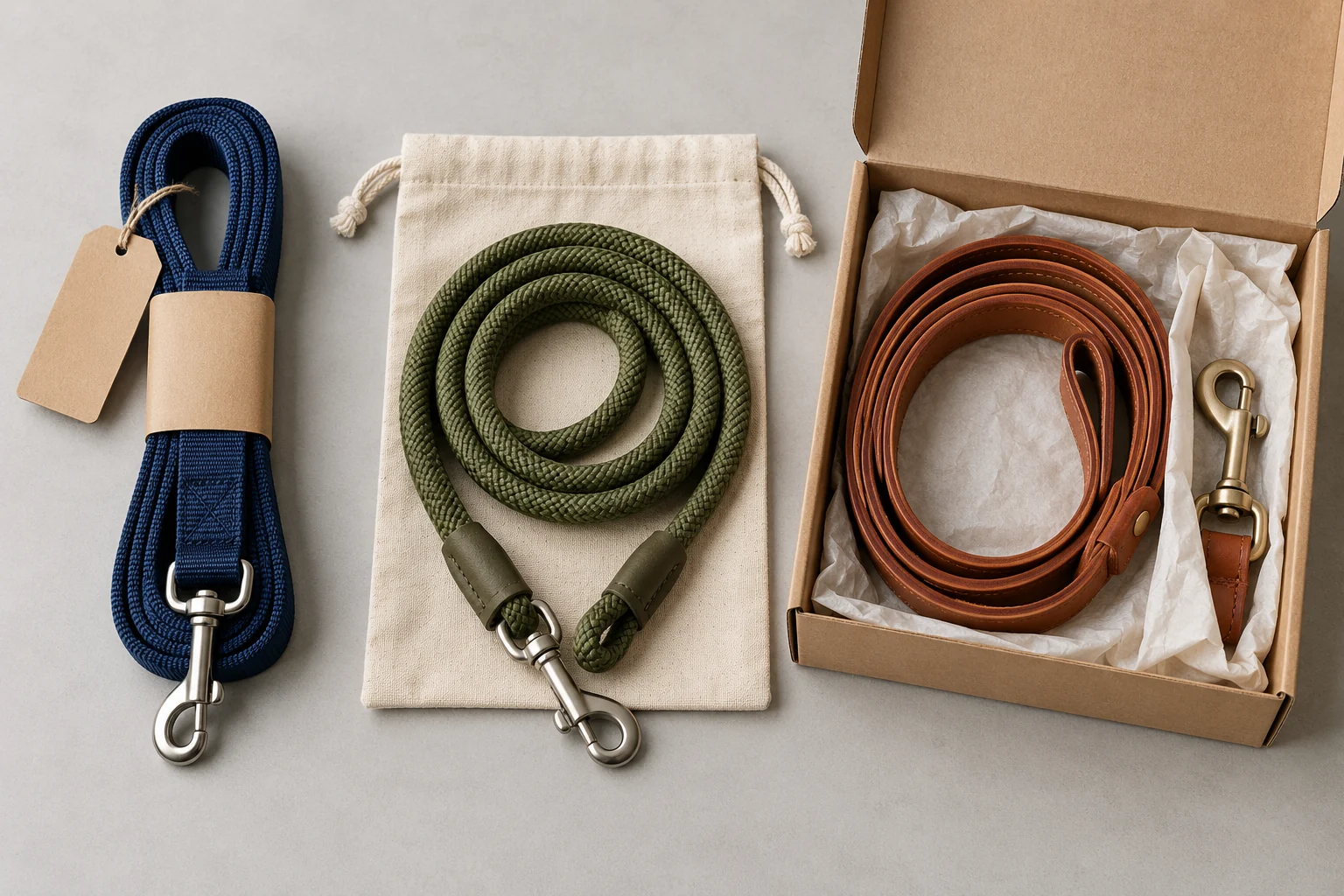
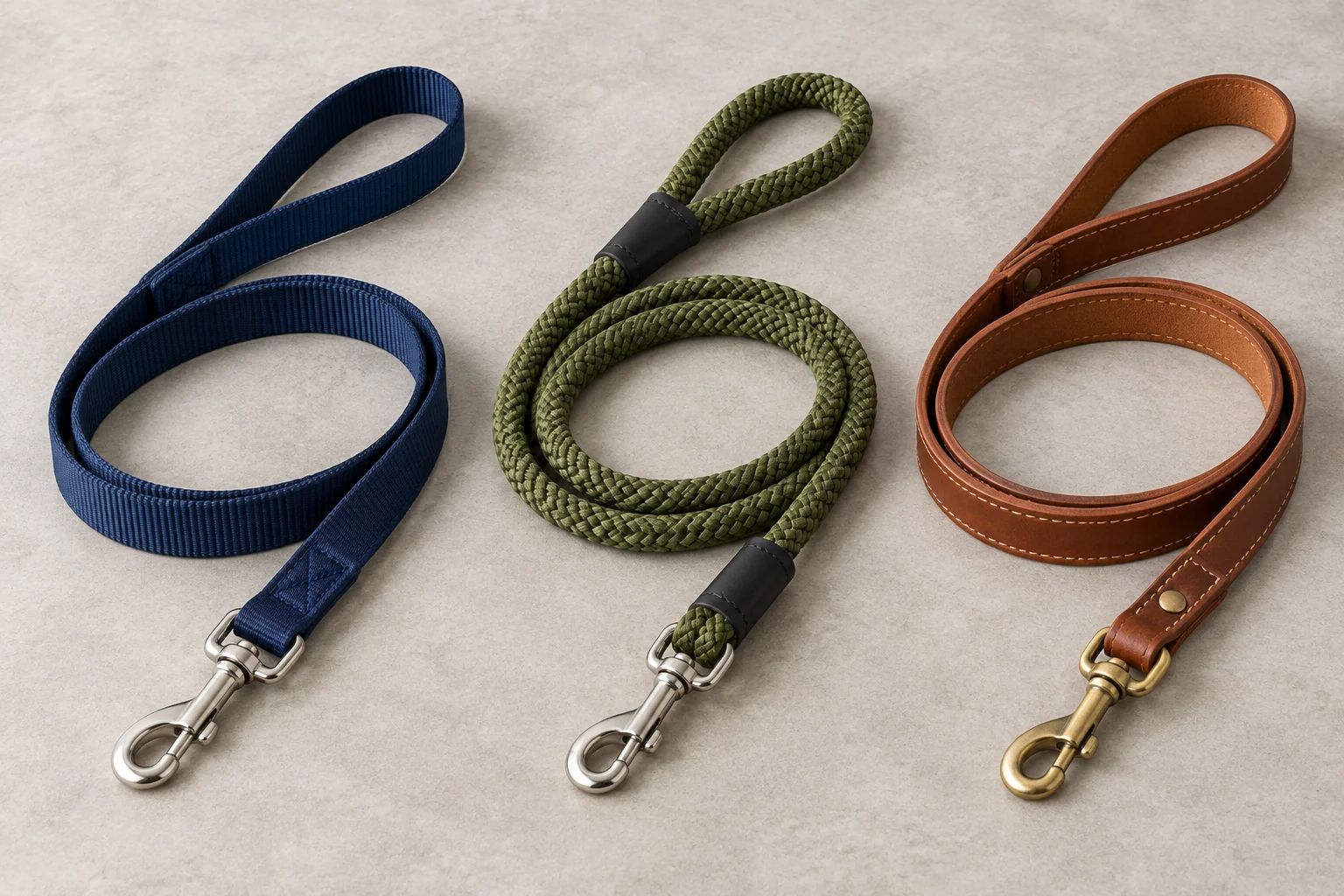
Nylon, braided rope, and leather dog leashes arranged side by side for material comparison

Table of Contents

Choosing a dog leash material looks simple until you start sourcing at scale.

On a sample table, nylon, rope, and leather can all look good. The difference usually appears later—when you start comparing quotations, checking hardware, reviewing stitching, approving colors, planning packaging, or dealing with repeat orders.

For a buyer, the real question is not:

“Which dog leash material is best?”

It is:

“Which material fits the product position, target customer, expected use, retail price, and production requirements of this order?”

A basic nylon leash for a volume retail program and a leather leash for a premium pet brand can both be good products, but they solve very different purchasing problems.

The same applies to rope. A rope leash may look stronger or more distinctive in product photography, but diameter, braid construction, hand feel, end finishing, and the connection to the hardware matter much more than the word “rope” on a quotation sheet.

Before requesting samples, buyers should compare nylon, rope, and leather from four angles:

  • product positioning;
  • material and construction;
  • manufacturing and QC risk;
  • total product value, not just unit price.

That is where the differences become useful.

Start With the Product Position, Not the Material

One of the most common sourcing mistakes is choosing the material too early.

A buyer may ask:

“Can you quote a nylon dog leash?”

But that still leaves most of the important decisions unanswered.

What type of leash are you trying to build?

A basic flat leash, padded leash, traffic lead, hands-free leash, training leash, reflective leash, or matching collar-and-leash set can all use nylon, but the specification and cost structure can be very different.

The same problem appears with rope and leather.

Before comparing materials, define as much as you already know about:

  • target retail channel;
  • intended retail price range;
  • dog size range;
  • leash width, diameter, and length;
  • intended visual style;
  • expected outdoor use;
  • preferred hardware;
  • logo method;
  • packaging format;
  • color range;
  • whether the leash will be sold individually or as part of a set.

You do not need to have every answer finalized before speaking with a supplier. The point is to define the direction of the product first.

If the target is a lightweight, colorful leash with multiple sizes and frequent color updates, nylon may make sense.

If the brand wants a more distinctive outdoor or lifestyle appearance, rope may give the product stronger visual identity.

If the goal is a premium accessory with a more traditional feel and higher perceived value, leather may be a better fit.

The material should support the product position—not determine it by itself.

Nylon Dog Leashes: Flexible, Scalable, and Easy to Customize

Nylon is often one of the easiest materials to work with for larger leash programs because it gives buyers many options in width, color, weave, printing, reflective details, padding, and hardware combinations.

But “nylon leash” is still too broad for a serious quotation.

Two nylon webbing samples can look similar and still differ in thickness, weave density, surface feel, edge finish, flexibility, and overall hand feel.

That affects both cost and the way the final leash feels in use.

What Buyers Should Check on Nylon Webbing

Do not evaluate nylon only by width.
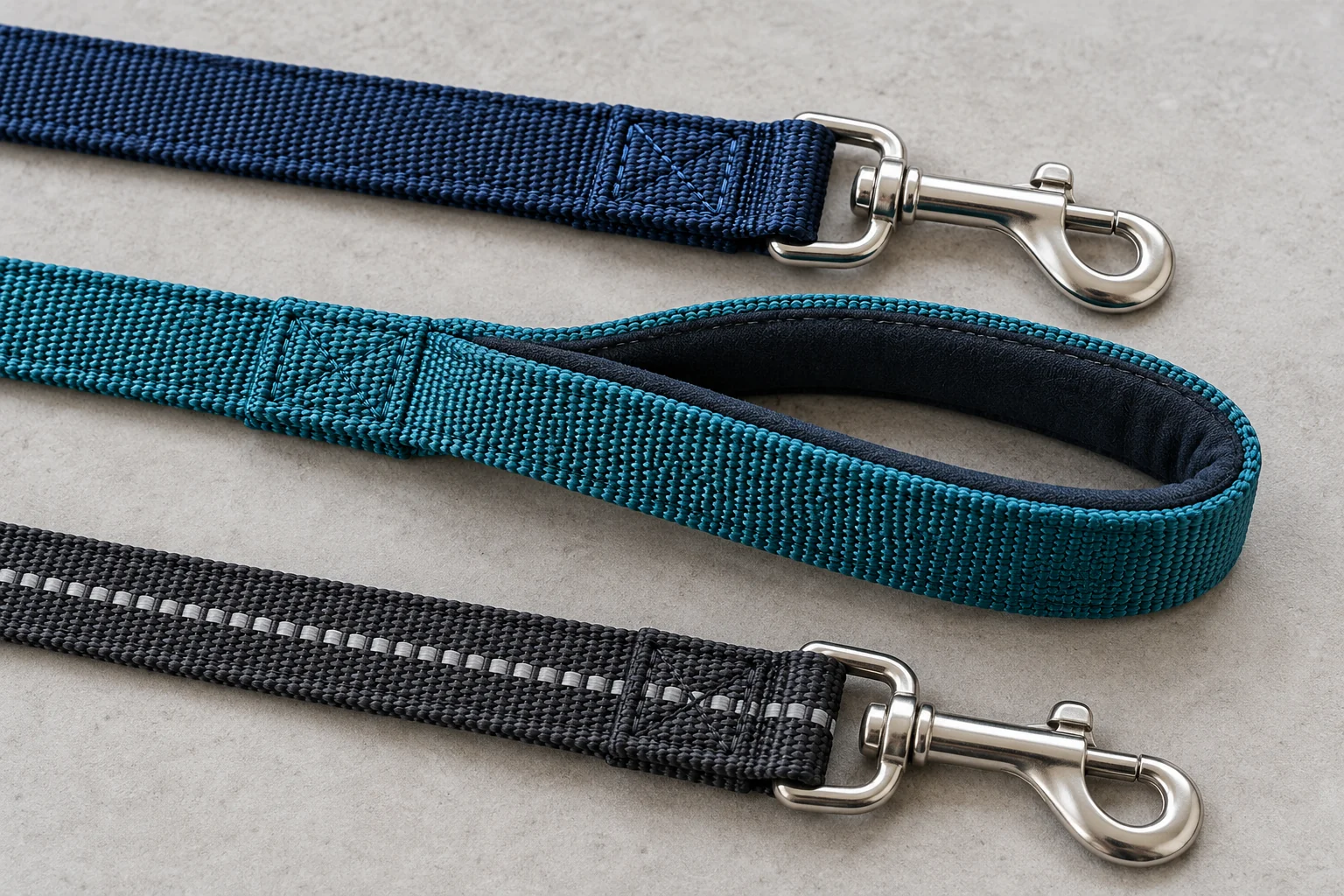
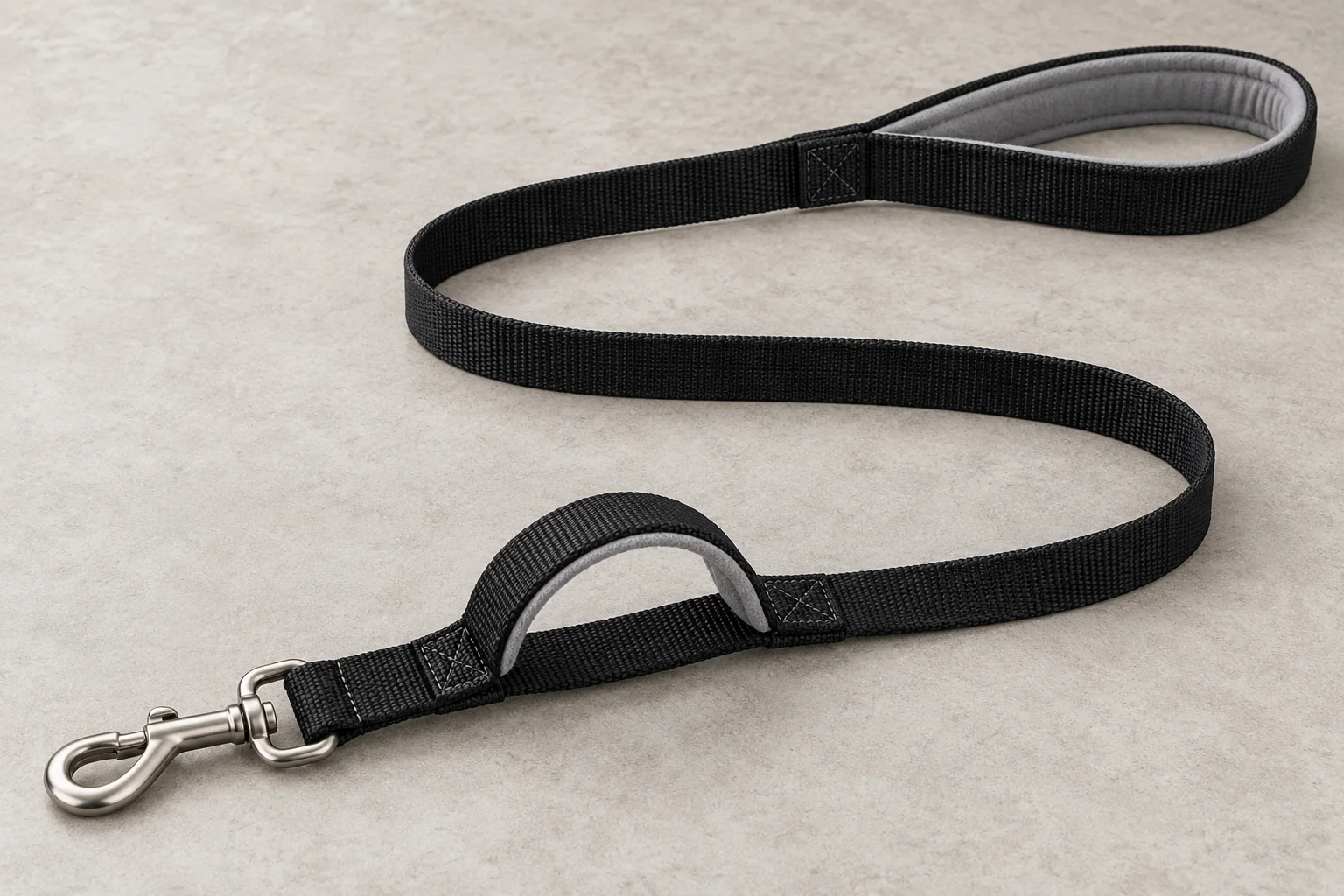
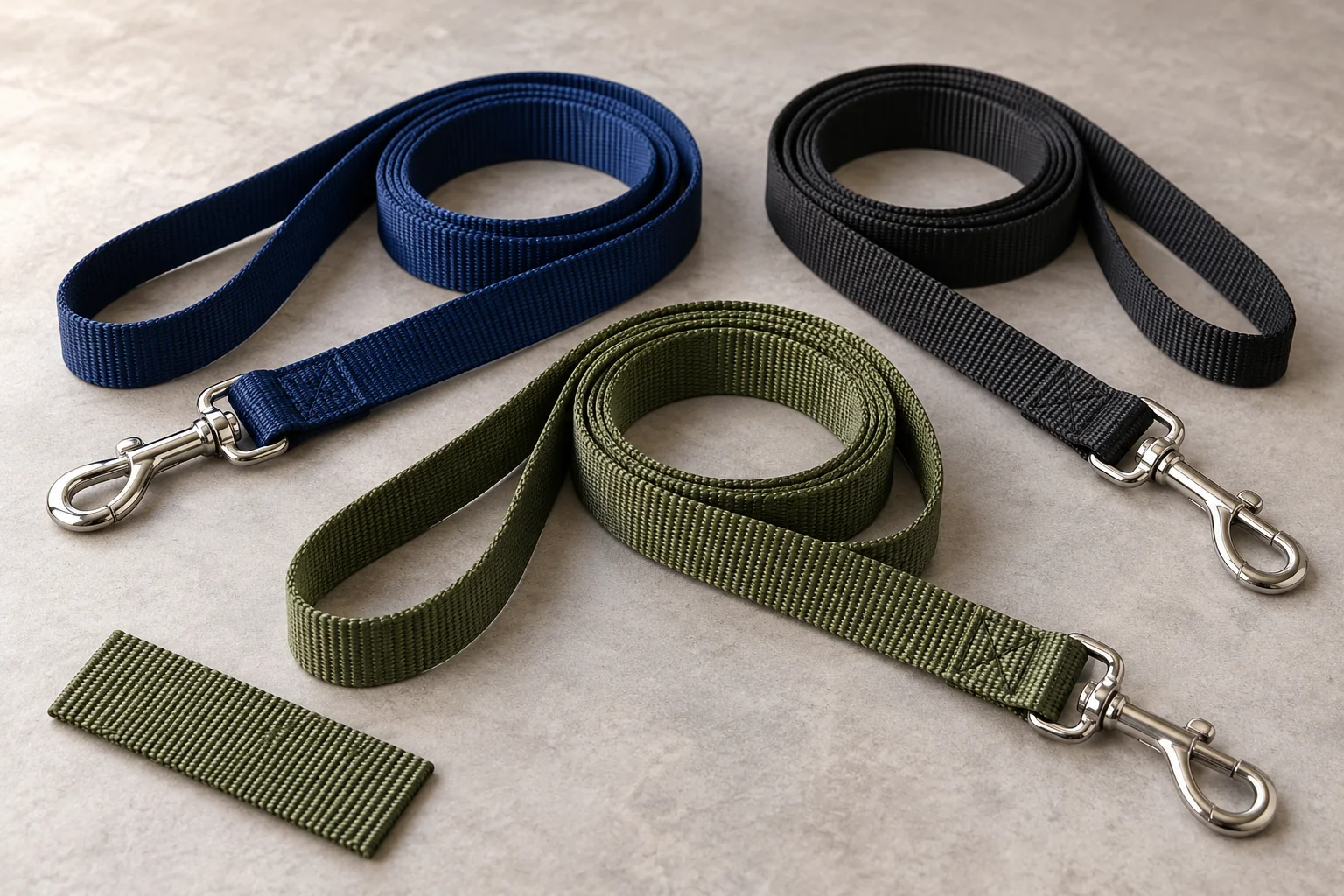
Nylon dog leash samples showing different webbing textures, folded stitching, and reflective details

Ask the supplier to clarify:

  • webbing width;
  • webbing thickness;
  • weave structure;
  • weight per meter where relevant;
  • surface texture;
  • edge condition;
  • color method;
  • whether reflective yarn or reflective tape is used;
  • whether the leash is single-layer or reinforced;
  • how folded areas and stress points are stitched.

A 20 mm leash made from thin webbing is not directly comparable with a 20 mm leash made from heavier, denser webbing.

The width may be identical. The hand feel, stiffness, appearance, and production cost may not.

This is why a good buyer does not compare nylon leash quotations only by size.

Why Nylon Works Well for Private Label Programs

Nylon is practical when a buyer wants:

  • several colors;
  • multiple sizes;
  • printed or woven branding;
  • matching collars or harnesses;
  • seasonal color updates;
  • retail packaging customization.

For a brand that changes collections frequently, this flexibility can matter more than a small difference in unit price.

The main sourcing risk is consistency.

One color may feel slightly different from another if webbing comes from different batches or sources. Dark colors and bright colors can also show differences in dye appearance, texture, or edge finish.

For larger programs, physical color samples are much more useful than approving colors only from a screen.

Rope Dog Leashes: Strong Visual Identity, but Construction Matters

Rope leashes are attractive because the material itself becomes part of the design.

A round braided leash has a very different appearance from flat nylon webbing, even before adding hardware or logos.

This can help brands create a more outdoor, nautical, climbing-inspired, or lifestyle-oriented product line.

But rope is also one of the materials where buyers should avoid making decisions based only on appearance.

Diameter Alone Does Not Tell You Enough

A supplier may quote an 8 mm, 10 mm, or 12 mm rope leash.

That sounds specific, but diameter is only one part of the specification.

Buyers should also ask:

  • what fiber the rope is made from;
  • how tightly it is braided;
  • whether it has an inner core;
  • how soft or stiff the finished rope feels;
  • whether the outer braid shifts under tension;
  • how the rope ends are secured;
  • how the rope connects to the snap hook or ring.

A thicker rope is not automatically a better rope.

If the braid is loose, the leash may feel bulky without feeling controlled.

If it is too stiff, it may look good in photos but feel uncomfortable in everyday use.

For rope products, hand feel should be part of sample approval.

Pay Attention to the End Connection

The connection between rope and hardware deserves particular attention.
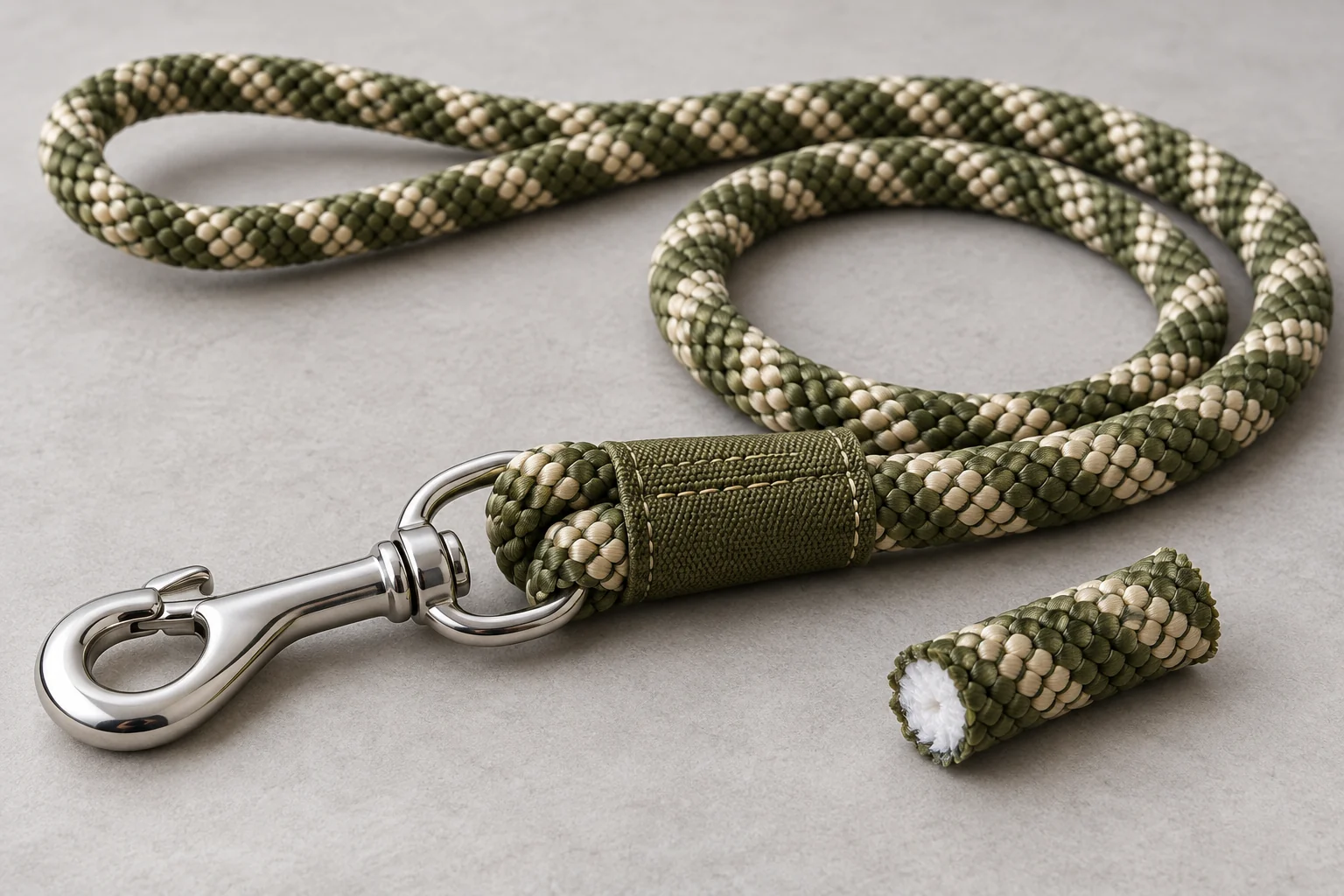
Braided rope dog leash with a reinforced hook connection and a separate cut sample exposing its inner core

Depending on the design, suppliers may use stitching, wrapping, sleeves, leather tabs, molded parts, or other reinforcement methods.

This area sees repeated movement and pulling, so buyers should inspect both appearance and construction.

On a sample, check whether:

  • the finishing is symmetrical;
  • the rope end is securely contained;
  • decorative wrapping can loosen;
  • the connection twists unexpectedly;
  • the finished end stays neat after repeated bending.

A rope leash can use a good rope material and still become a poor product if the end construction is badly designed.

Leather Dog Leashes: Premium Positioning Requires Better Material Control

Leather is often chosen because of appearance, feel, and perceived value.

But from a sourcing perspective, leather is less standardized than many buyers expect.

The phrase “genuine leather” alone does not tell you enough about how the finished leash will look, feel, age, or perform.

Different leather selections, thicknesses, surface treatments, backing constructions, edge finishes, and stitching methods can create very different products.

Ask for the Actual Leather Specification

For a leather leash, buyers should confirm more than just color.

Useful questions include:

  • what type of leather is being used;
  • leather thickness;
  • whether construction is single-layer or layered;
  • whether the reverse side is finished or lined;
  • edge finishing method;
  • surface finish;
  • softness and flexibility;
  • stitching type;
  • reinforcement at stress points.

If a supplier provides only a color card and says “real leather,” the specification is not complete enough for consistent repeat orders.

Leather Needs More Sample Evaluation

Leather naturally shows more variation than many synthetic materials.
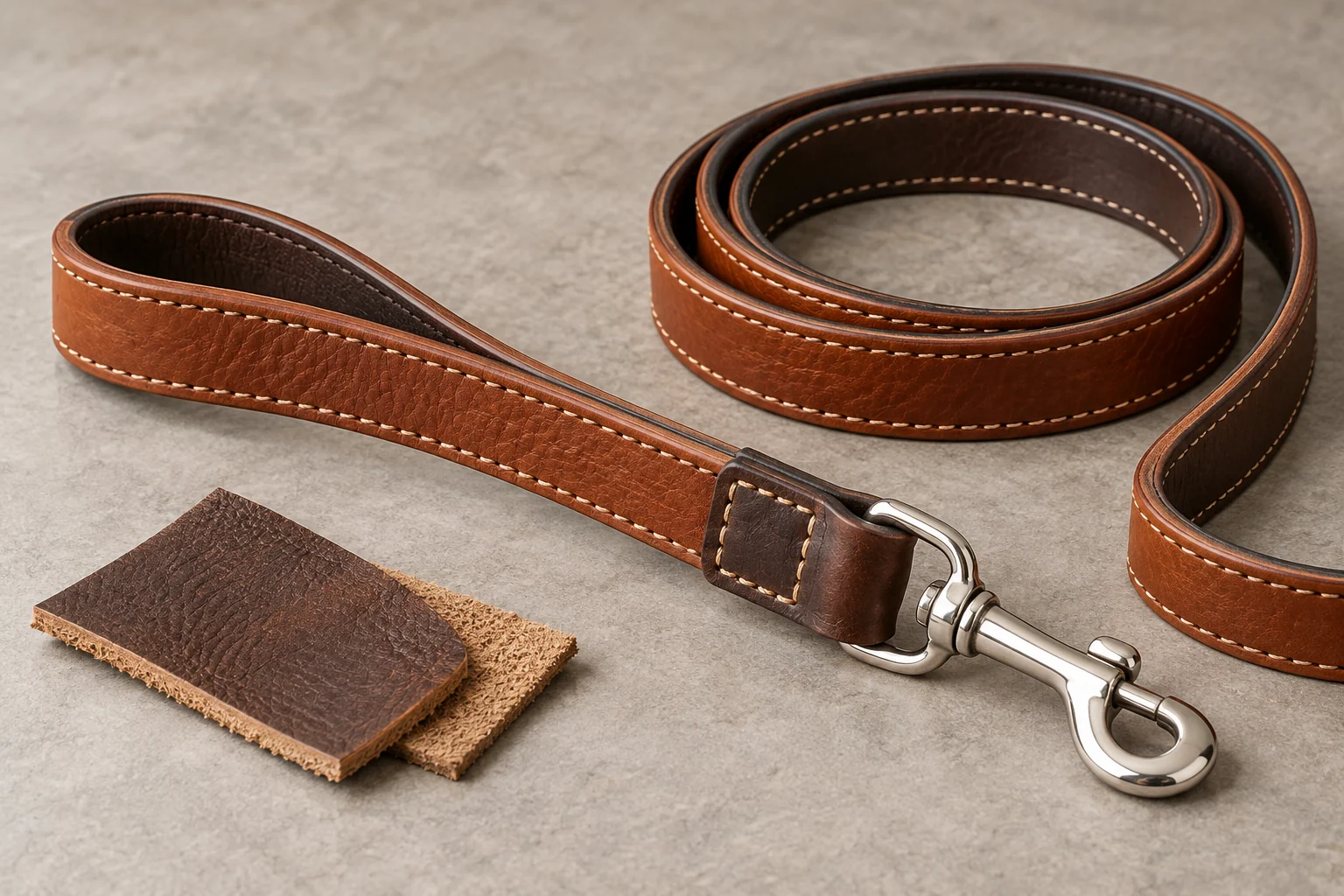
Brown leather dog leash samples showing natural grain, finished edges, stitching, and hardware attachment

That is not automatically a defect, but the buyer and supplier need to agree on what level of variation is acceptable.

Compare samples for:

  • color variation;
  • surface grain;
  • thickness;
  • stiffness;
  • edge appearance;
  • stitch spacing;
  • hole or rivet placement;
  • hardware alignment.

This matters especially for premium brands.

A customer paying more for a leather leash is more likely to notice small finishing differences that might be ignored on a lower-priced utility product.

The QC standard should match the retail position.

Hardware Can Matter as Much as the Leash Material

Buyers sometimes spend too much time comparing leash materials and too little time comparing hardware.
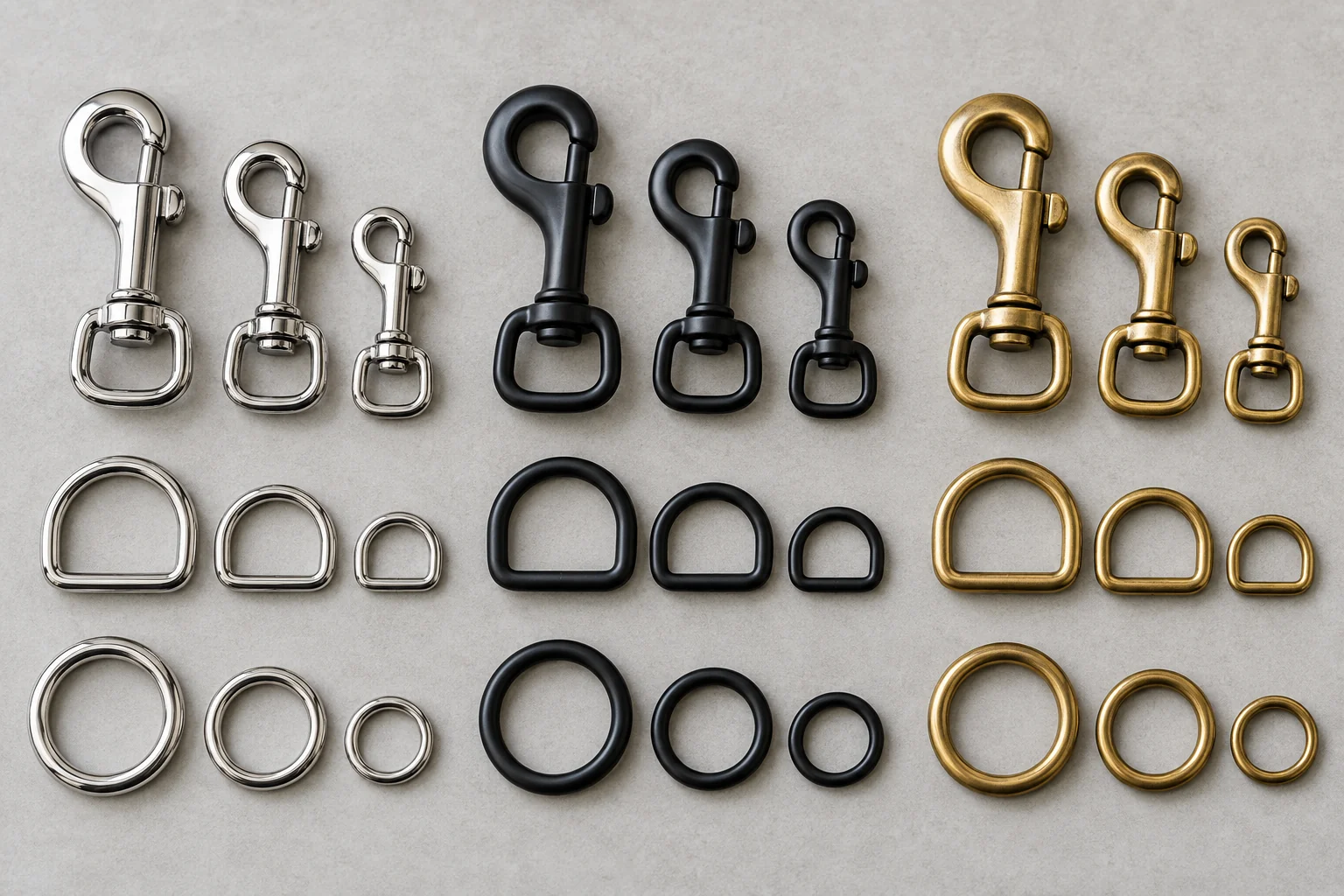
Dog leash swivel snap hooks, D-rings, and O-rings in silver, black, and brass-colored finishes

But snap hooks, D-rings, O-rings, adjusters, rivets, and other metal parts can affect both appearance and reliability.

Two suppliers may quote what appears to be the same nylon leash at different prices because one uses a heavier hook, a different finish, or a more complex connection method.

When comparing quotations, ask suppliers to identify the hardware clearly.

Check:

  • hook type;
  • hook size;
  • base metal;
  • surface finish;
  • swivel function;
  • opening action;
  • ring thickness;
  • color consistency across metal parts.

A black leash with several noticeably different black metal finishes can look inexpensive even if every component technically works.

For branded products, hardware finish consistency is part of the visual standard.

Nylon vs Rope vs Leather: What Actually Changes the Cost?

Material cost matters, but it is only one part of the quotation.

For all three leash types, price can be affected by:

  • leash width or rope diameter;
  • length;
  • material thickness;
  • number of layers;
  • hardware size and finish;
  • stitching complexity;
  • padding;
  • reflective components;
  • logo method;
  • custom colors;
  • packaging;
  • order quantity;
  • number of SKUs in the order.

This is why buyers should avoid comparing only the final unit price.

One quotation may include a standard hook and simple bulk packing.

Another may include custom plating, branded hardware, individual retail packaging, barcode labels, and multiple colorways.

Those are not equivalent quotations.

You Do Not Need a Perfect RFQ Before Contacting a Supplier

A better RFQ separates the product into components, but that does not mean every specification needs to be finalized before you contact a supplier.

Start with what you already know.

Tell us:

  • which material you are considering;
  • approximate leash length and width or rope diameter;
  • preferred hardware style;
  • logo idea;
  • color direction;
  • packaging concept;
  • target market;
  • approximate order plan.

If some details are still undecided, that is normal.

You can send a reference photo, competitor product, sketch, existing sample, or even a short explanation of the kind of product you want to build.

For example:

“We are developing a nylon dog leash for our retail brand. We want a clean design, custom colors and logo, and retail-ready packaging. We are still comparing webbing thickness and hook options. Can you recommend suitable specifications and quote the available options?”

That is already enough to start a useful conversation.

A supplier can then help narrow down suitable constructions before sampling and final quotation.

This is much more productive than asking only:

“What is your price?”

Which Material Is Better for Custom Branding?

For branding flexibility, nylon is often the easiest starting point.

Depending on the design, buyers may consider:

  • woven labels;
  • rubber labels;
  • printed logos;
  • custom webbing;
  • metal logo plates;
  • branded packaging.

Rope products often rely more heavily on accessories and finishing details for branding, such as sleeves, leather patches, tags, or branded hardware.

Leather can support embossing, debossing, metal branding, and other premium-looking treatments, but the result depends heavily on the leather surface and finish.
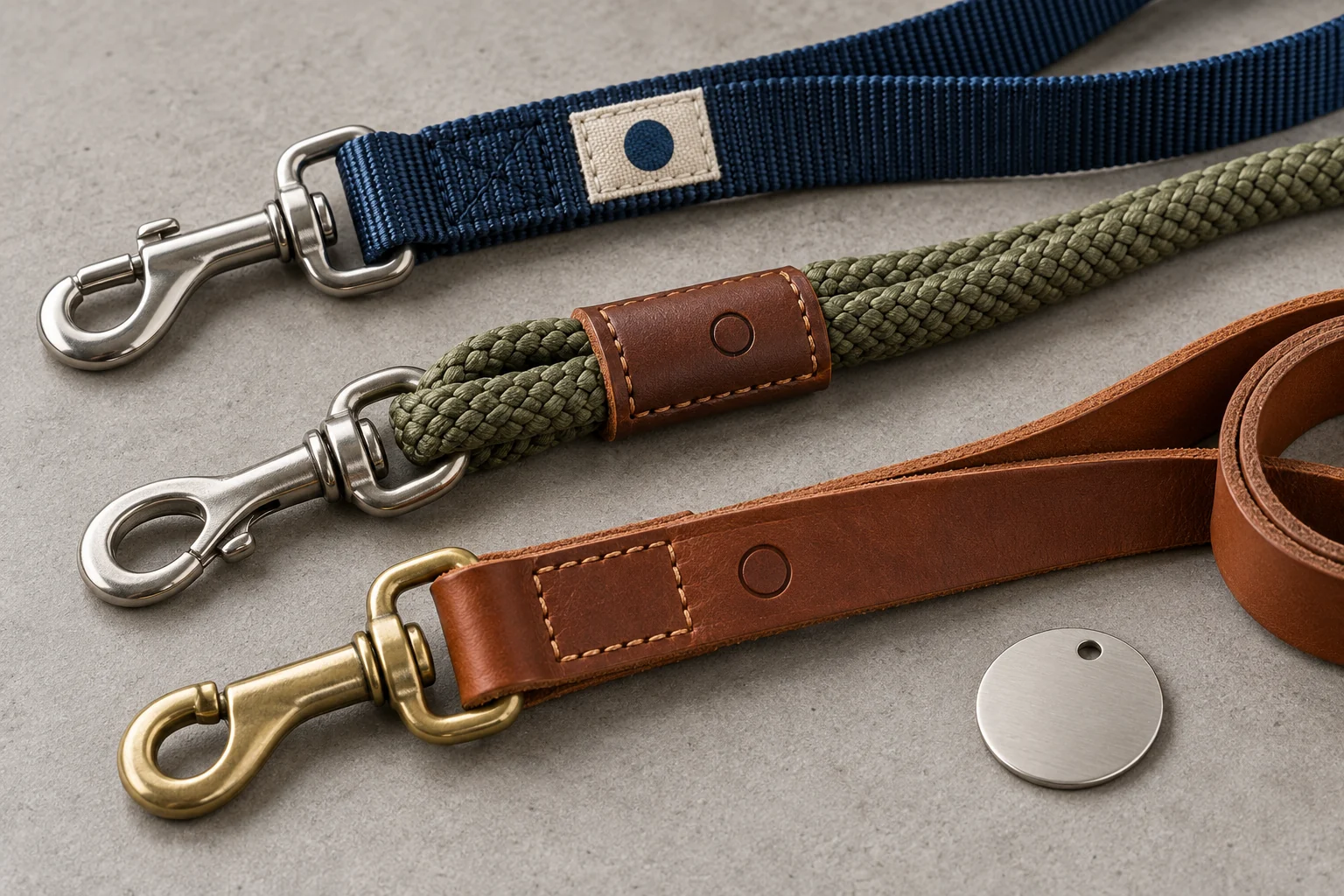
Nylon, rope, and leather dog leash samples with woven labels, a sleeve patch, and a debossed mark

Before approving a logo method, ask for an actual sample on the production material.

A logo that looks good in a digital mockup may be too shallow, too small, or poorly positioned on the real leash.

Packaging Should Be Decided Before Final Pricing

Packaging is often treated as a final step, but it affects quotation accuracy and production planning.

A leash can be packed with:

  • a simple hang tag;
  • paper sleeve;
  • retail card;
  • pouch;
  • box;
  • custom insert;
  • barcode or SKU label.
Dog leash retail packaging options including a hang tag, paper sleeve, pouch, and protective box

For importers and retail programs, packaging dimensions can also affect carton planning.

Leather products may need extra protection against surface marks.

Metal hardware may need to be separated from finished surfaces.

Rope products can take up more volume depending on how they are coiled.

If you already have a retail packaging concept, share it during quotation rather than waiting until the product sample is finished.

If you do not have the packaging finalized yet, tell the supplier what sales channel you are targeting. That gives both sides a better starting point for discussing options.

Sample Approval Should Cover More Than Appearance

A sourcing sample is not only for checking whether the leash “looks right.”
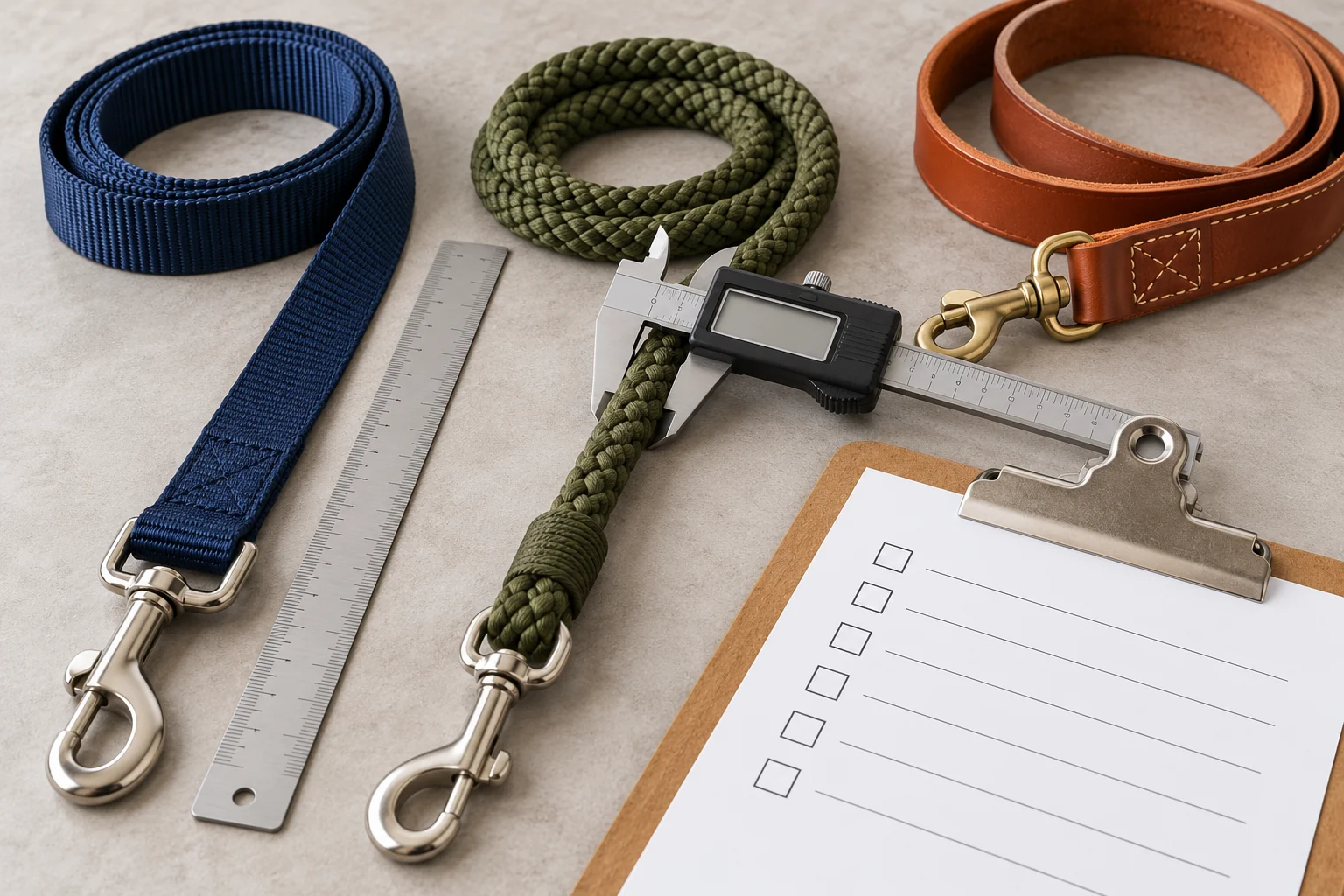
Nylon, rope, and leather dog leash samples arranged with measurement tools for quality inspection

Use the sample to create a production reference.

For nylon, check:

  • webbing;
  • stitching;
  • edge finish;
  • logo;
  • hardware;
  • color.

For rope, check:

  • diameter;
  • hand feel;
  • braid consistency;
  • end finishing;
  • connection points.

For leather, check:

  • thickness;
  • surface;
  • edge finishing;
  • stitching;
  • flexibility;
  • hardware;
  • color variation.

For all materials, check dimensions and packaging.

If changes are made after the first sample, record them clearly.

Do not rely on comments such as:

“Please make it slightly stronger.”

That is difficult to reproduce.

It is much better to say exactly what should change:

  • thicker webbing;
  • larger hook;
  • different stitching pattern;
  • softer rope;
  • revised leather thickness;
  • new logo position;
  • different packaging.

A good sample approval process reduces arguments later because both sides have a physical and written reference.

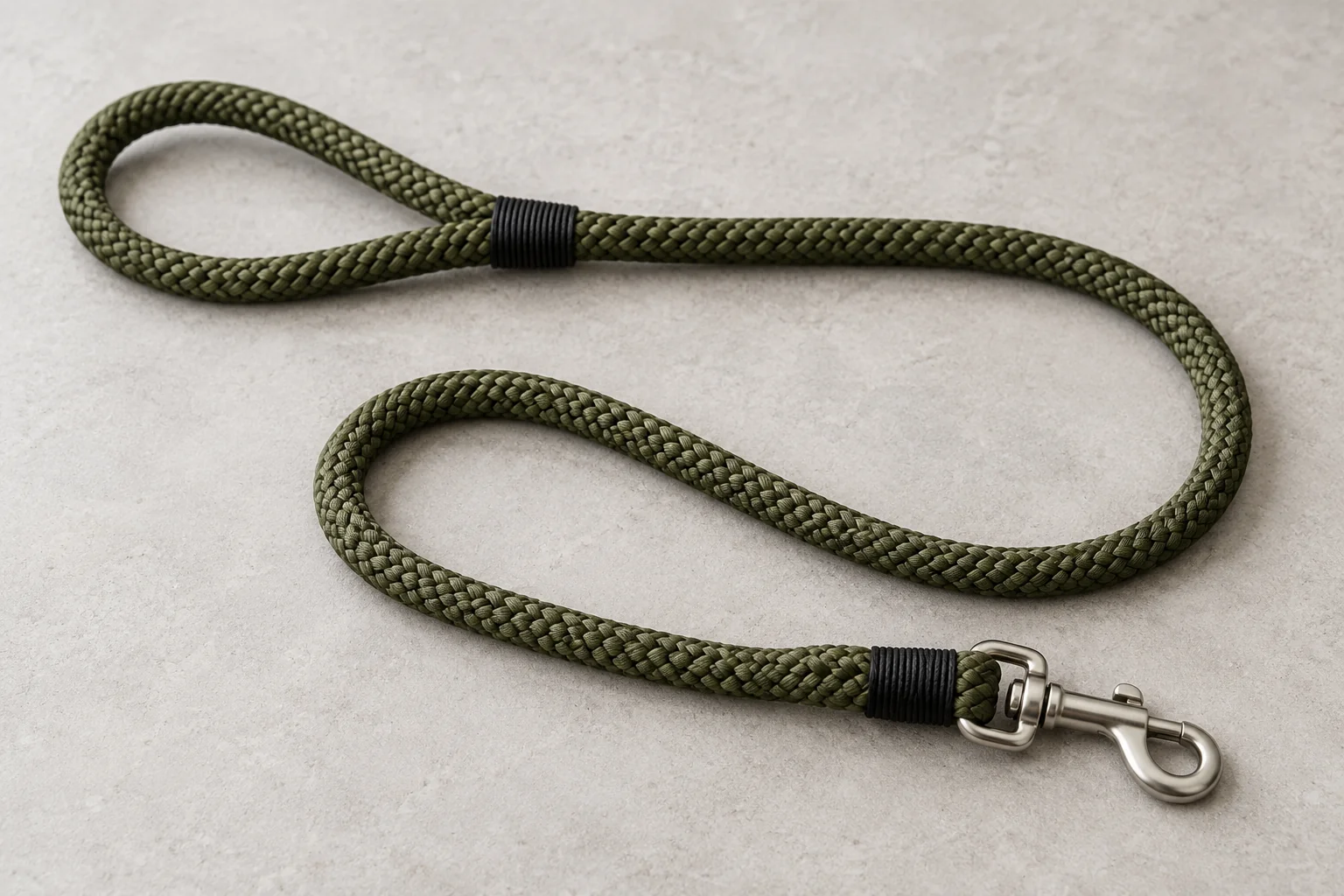
QC Should Follow the Product’s Real Failure Points

QC should not be identical for every leash.

Different materials create different risks.

For nylon products, buyers may pay closer attention to:

  • webbing defects;
  • stitching;
  • color consistency;
  • cut ends;
  • hardware attachment.

For rope leashes, check:

  • braid consistency;
  • diameter;
  • end finishing;
  • connection security.

For leather, pay closer attention to:

  • surface quality;
  • thickness variation;
  • stitching;
  • edge finishing;
  • hardware positioning.

Across all leash types, basic checks normally include:

  • dimensions;
  • workmanship;
  • logo position;
  • hardware function;
  • color;
  • packaging;
  • quantity;
  • visible defects.

If your market requires specific testing or compliance documentation, discuss those requirements before production rather than after the goods are completed.

Testing expectations should be part of the sourcing discussion from the beginning.

When Nylon Is the Better Choice

Nylon is often a practical choice when the buyer needs broad customization, multiple colors, predictable production, and a product that can fit several retail price levels.

It also works well for programs where the buyer wants to create a coordinated product family across collars, leashes, and harnesses.

The decision should still be based on the actual webbing specification, not simply the word “nylon.”

When Rope Is the Better Choice

Rope makes sense when design identity matters strongly.

It can help a brand create a product that looks different from standard flat-webbing leashes and can support outdoor or lifestyle positioning.

The important part is to define diameter, hand feel, construction, end finishing, and hardware clearly.

If those details are vague, two rope leash quotations may not represent the same product at all.

When Leather Is the Better Choice

Leather is usually considered when the product needs a more premium appearance and the brand is prepared to manage more material variation and finishing detail.

It may also make sense when the leash is part of a coordinated premium collection.

For leather sourcing, sample approval and workmanship standards are especially important because small finishing differences are easy to see.

Do Not Choose by Material Alone

For most B2B buyers, the best leash is not determined by whether nylon, rope, or leather is theoretically superior.

A better decision comes from matching the material to:

  • target customer;
  • retail channel;
  • price positioning;
  • required appearance;
  • customization;
  • expected use;
  • packaging;
  • QC standard;
  • reorder strategy.

A well-specified nylon leash can be a better commercial product than an expensive leather leash with inconsistent finishing.

A rope leash with a strong visual identity may be a better choice than either one—but only if its construction details are properly controlled.

Before comparing final prices, make sure suppliers are quoting against roughly the same product concept.

That is what makes the quotation useful.

Planning a Dog Leash Range? Start With a Conversation

You do not need to have the full specification ready before contacting us.

If you are developing a dog leash range, send us whatever you already have:

  • a product idea;
  • reference images;
  • an existing sample;
  • preferred material;
  • hardware style;
  • logo concept;
  • packaging idea;
  • target market;
  • approximate quantity;
  • or simply the type of customer you want the product to serve.

If you are still deciding between nylon, rope, or leather, that is fine too.

Tell us what you want the product to achieve, where you plan to sell it, and what kind of price or brand position you are aiming for.

We can discuss the practical differences with you, compare possible constructions, and work through the specification before you move into sampling or formal quotation.

Send us a message and tell us what you are working on.

Your Reliable Pet Products Partner

Factory warehouse storing and packing assorted pet products for shipment
We supply a wide range of pet products for brands, wholesalers, and retailers worldwide. From product customization and packaging to bulk orders and shipping, we provide flexible OEM/ODM solutions to support your business.

Tell Us About Your Pet Product Project

Sample Evaluation

Confirm sample availability, any charges and freight before reviewing the product.

OEM Customization

Review product-specific branding, material and packaging options before sampling.

Production Planning

Agree on production lead time and shipping handover after sample approval.

Responsive Support

From initial consultation to after-sales, we’re with you in every step.