Table of Contents
A practical guide to weave, sample decisions, and consistent bulk orders
Two suppliers quote a black, 20 mm nylon dog leash with a silver swivel hook. One price is lower. It is tempting to negotiate immediately, but I would ask a different question first: are they actually offering the same leash? A photo cannot tell you whether the webbing, hook, joining method and packaging are comparable.
For wholesale and private-label buyers, the goal is not to find the thickest strap or the most impressive-looking hook. It is to choose a construction that makes sense for the end customer—and then make sure the quotation, approved sample and production specification all describe that same product. Here is how to make those decisions without paying for unnecessary upgrades or overlooking the details that matter.
Start with the product, not a generic price request
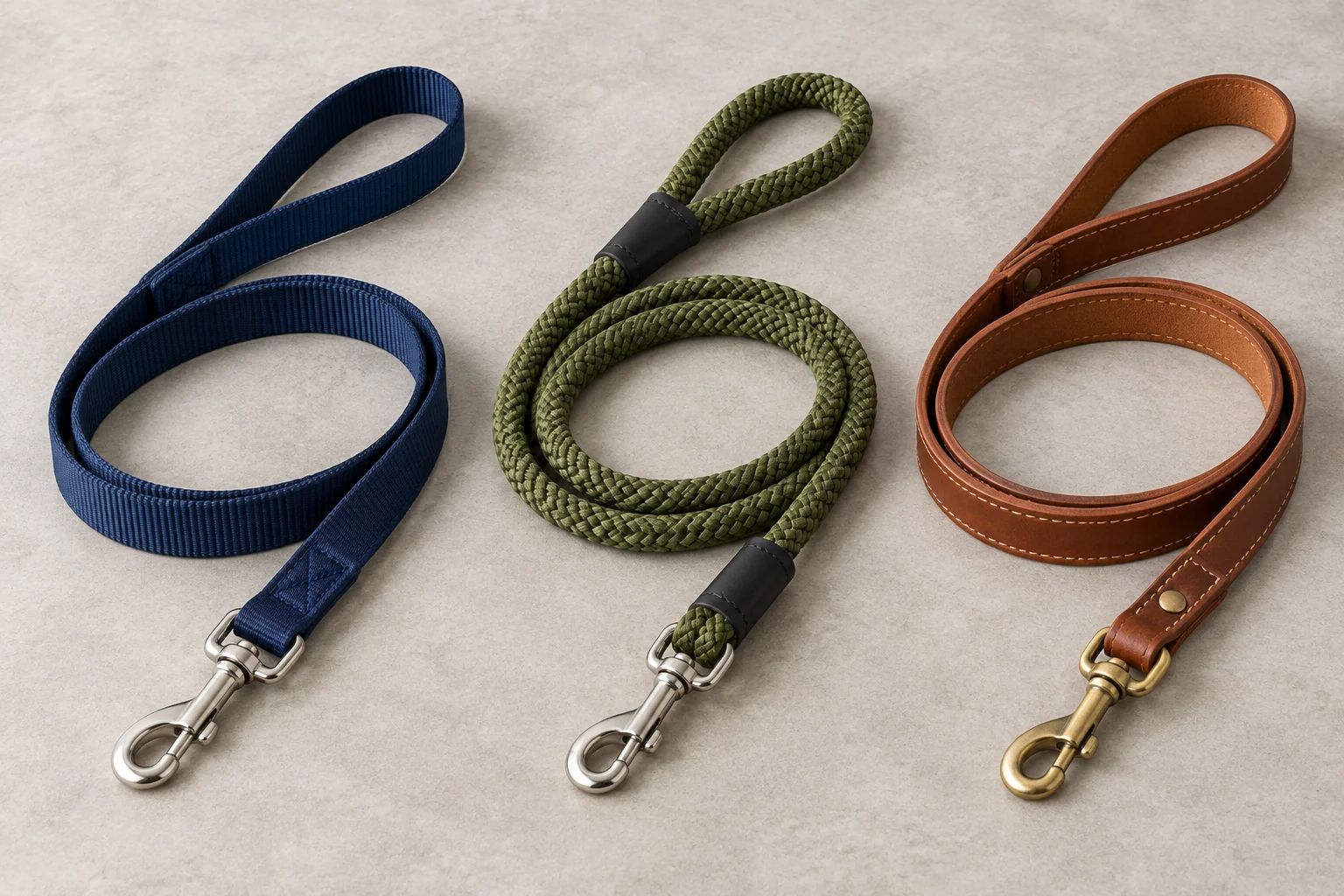
Think first about where the leash will be sold, who will use it and what you want to improve from a reference design. A lightweight everyday range, a coordinated collar-and-leash collection and an outdoor-oriented product can call for different materials, handle designs and hardware. There is little value in comparing quotations until that direction is reasonably clear.
A photo or existing sample is a perfectly reasonable starting point. Mark the details you want to keep and the ones you would consider changing. For example, you might like the handle shape but want to compare a softer webbing and a different hook. That gives a supplier something useful to respond to; “better quality,” on its own, does not.
For a range with several colors and sizes, the quantity per variation matters more than one headline quantity. Custom-colored webbing, hardware, labels and retail packaging may have their own minimums or setup charges. A plan for 1,000 pieces spread across ten designs is not automatically equivalent to 1,000 pieces of one design. You can begin with estimates, then refine the breakdown as the range takes shape.
Are the quotations actually comparable?
This is the comparison sheet I would use before arguing over price. If a field is missing, mark it “not confirmed” rather than assuming it matches the reference sample. That simple distinction can prevent a surprising number of disagreements later.
Compare | Ask the supplier to identify |
|---|---|
Webbing | Fiber composition, supplier reference, width, thickness and construction. Request a physical swatch when available. |
Finished dimensions | Overall length, handle opening and measurement method. Clarify whether the stated length includes the hook. |
Hardware | Hook reference, base material, dimensions, weight if relevant, finish and swivel design. |
Connections | Fold or overlap length, joining method, thread specification and stitch pattern. |
Branding and colors | Logo method, size and position; physical color reference; any setup charges. |
Packaging | Bulk or individual packing, retail card or label, barcode requirements and carton arrangement. |
Order structure | Quantity per size and color, component minimums and any charges for small batches. |
Commercial terms | Currency, delivery term or delivery point, and whether freight, sampling, testing and setup are included or separate. |
Timing | Sample and production lead times, and what must be approved before each period begins. |
Consider a hypothetical comparison: Supplier A includes a standard hook and bulk packing; Supplier B includes a different hook, a woven label and individual retail cards. Supplier B may look more expensive, but the two offers are not equivalent. Ask both to price the same construction first. Then request separately priced alternatives so you can see exactly what each upgrade—or simplification—changes.
Where I would look for savings first
If a quote exceeds your target cost, I would usually look at decorative hardware finishes, custom accessories, packaging complexity and the number of colorways before quietly reducing the quality of a connection. A simpler retail card might be acceptable; an unreviewed hook substitution is a different kind of decision. It can change handling and may require the finished assembly to be evaluated again.
That is not a rule that packaging never matters. For a premium gift set, presentation may be central to the product. The point is to separate changes that affect the customer experience or the assembled leash from changes that mainly affect appearance or logistics. Price becomes easier to manage when the trade-off is visible.
Width and thickness: judge the finished leash
Widths such as 10, 15, 20 and 25 mm appear in leash designs, but they are examples, not universal size or safety standards. Width alone cannot establish suitability for a particular dog. The webbing, stitching and hardware need to be evaluated together.
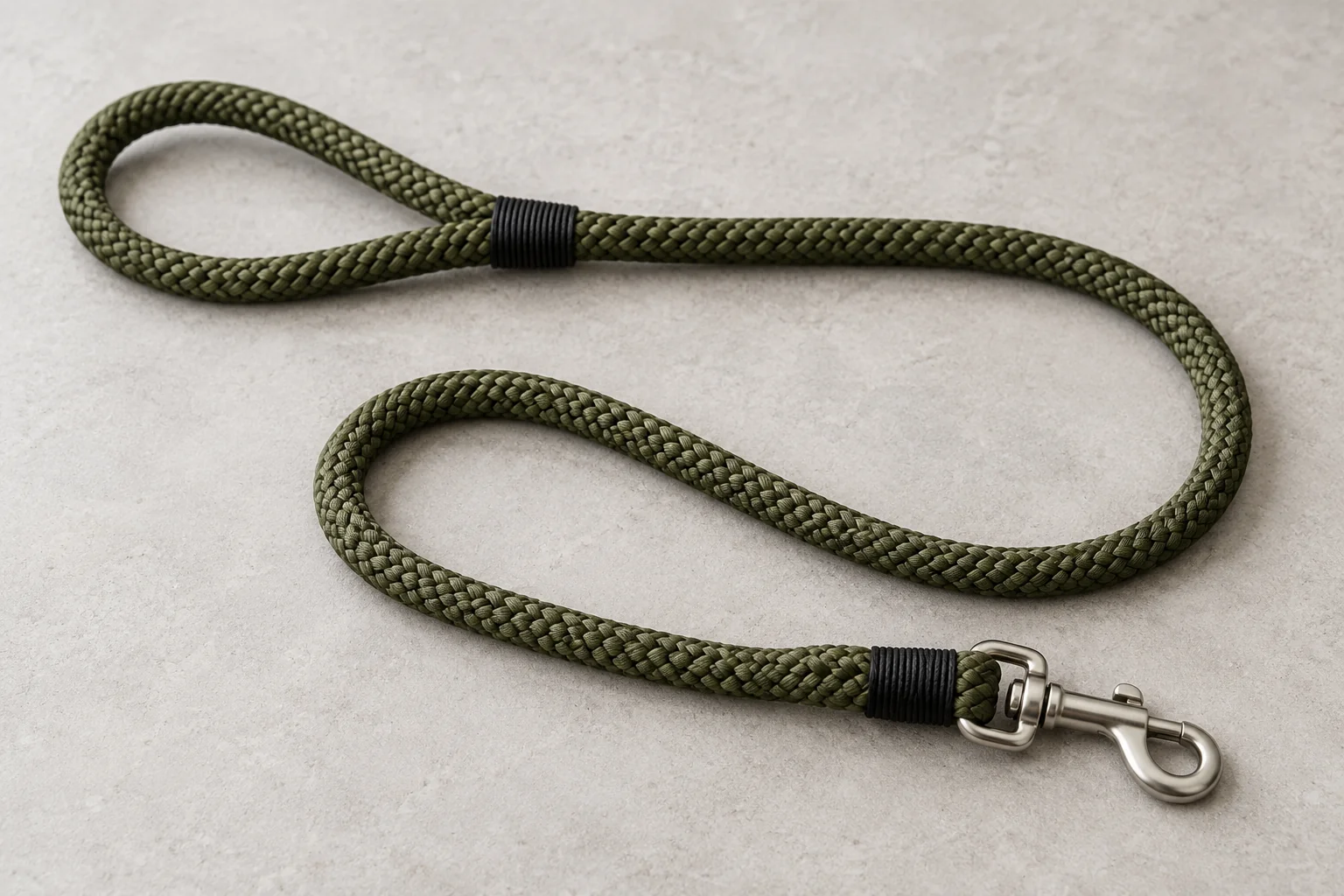
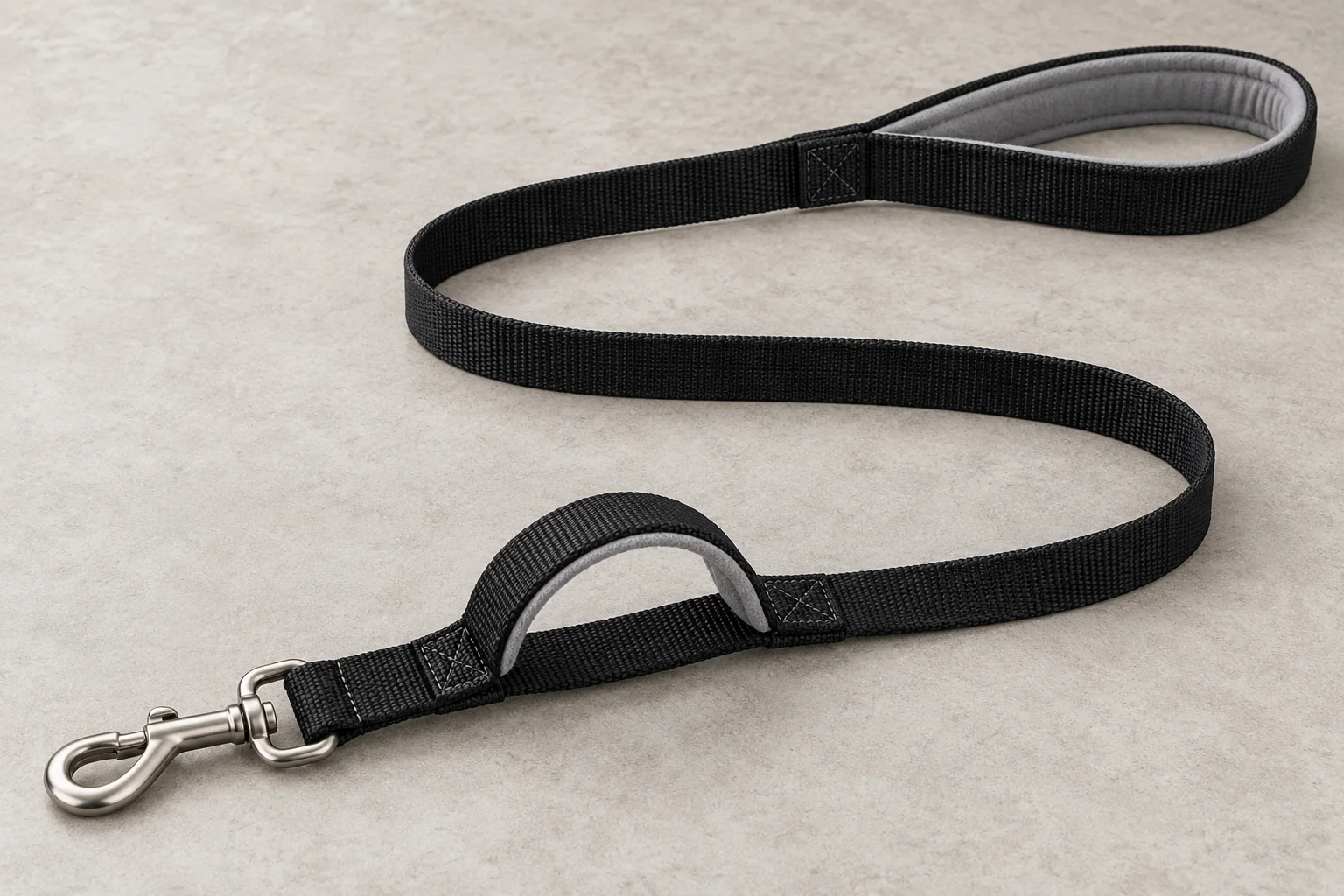
Compare candidate widths with the handle and hook actually attached. How does the loop sit in the hand? Is the leash easy to coil? Does the hook feel disproportionate to the strap? A compact everyday design can feel clumsy with an oversized hook, while a wider strap may look reassuring without being the right choice for every product. For multi-size ranges, examine each assembly instead of automatically fitting the same hardware everywhere.
Thickness belongs in the specification alongside width. Two nominally 20 mm straps can feel quite different when folded around a hand. If thickness will be an acceptance criterion, agree on where and how it is measured and what tolerance applies. An unqualified number is not enough to settle a later production dispute.
Handling a sample tells you about comfort, bulk and flexibility; it does not establish a safe working load. Keep those observations separate from the evidence needed to verify the complete leash against the performance requirements of its intended use.
Weave, fiber and finish: why similar straps feel different
A label such as “nylon-style webbing” does not establish fiber composition. Ask what will actually be supplied, especially if your brand specifies nylon rather than another synthetic fiber. Similar-looking straps can have different characteristics, and a material claim should be supported by the documentation or verification your product requires.
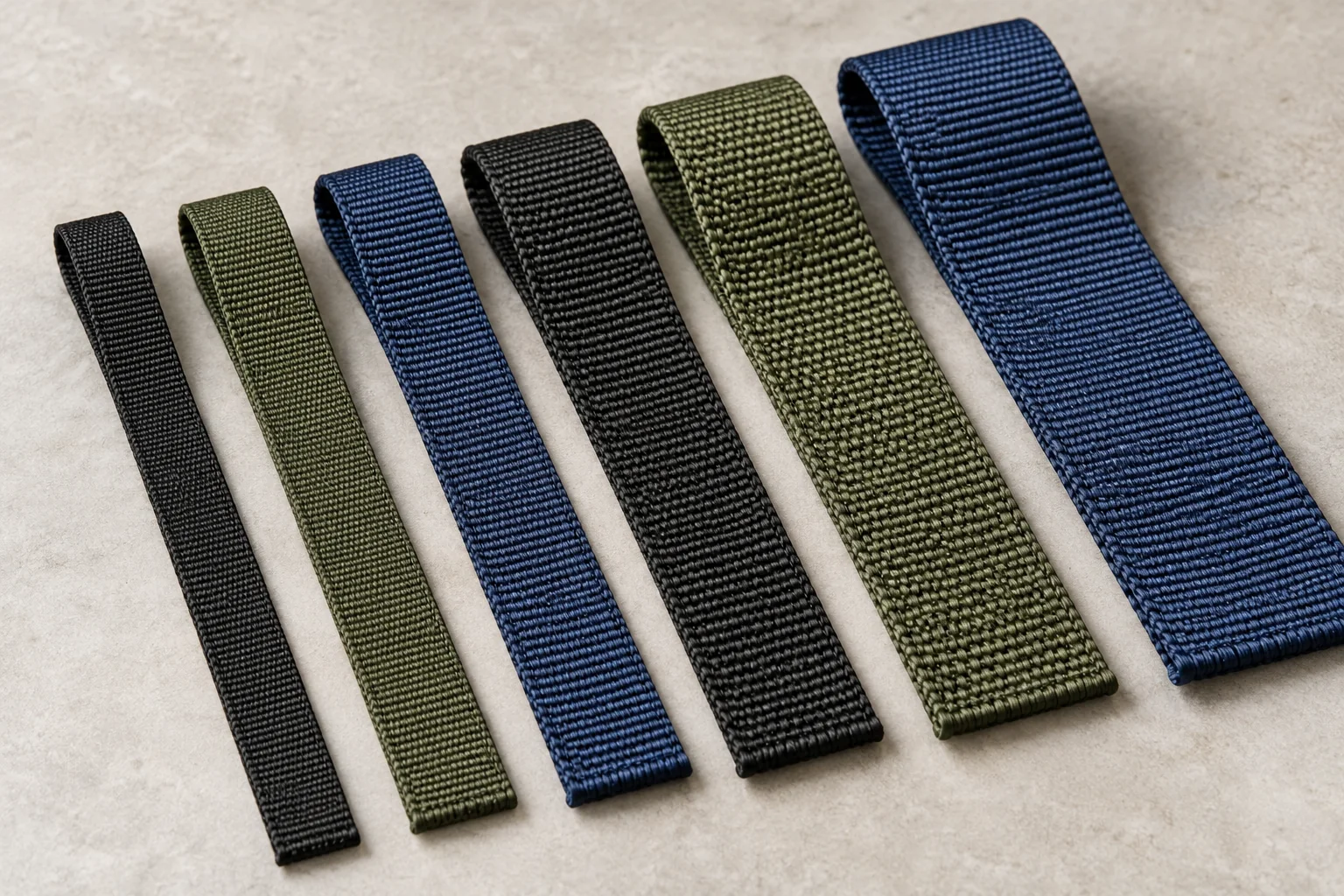
What the weave changes—and what it does not prove
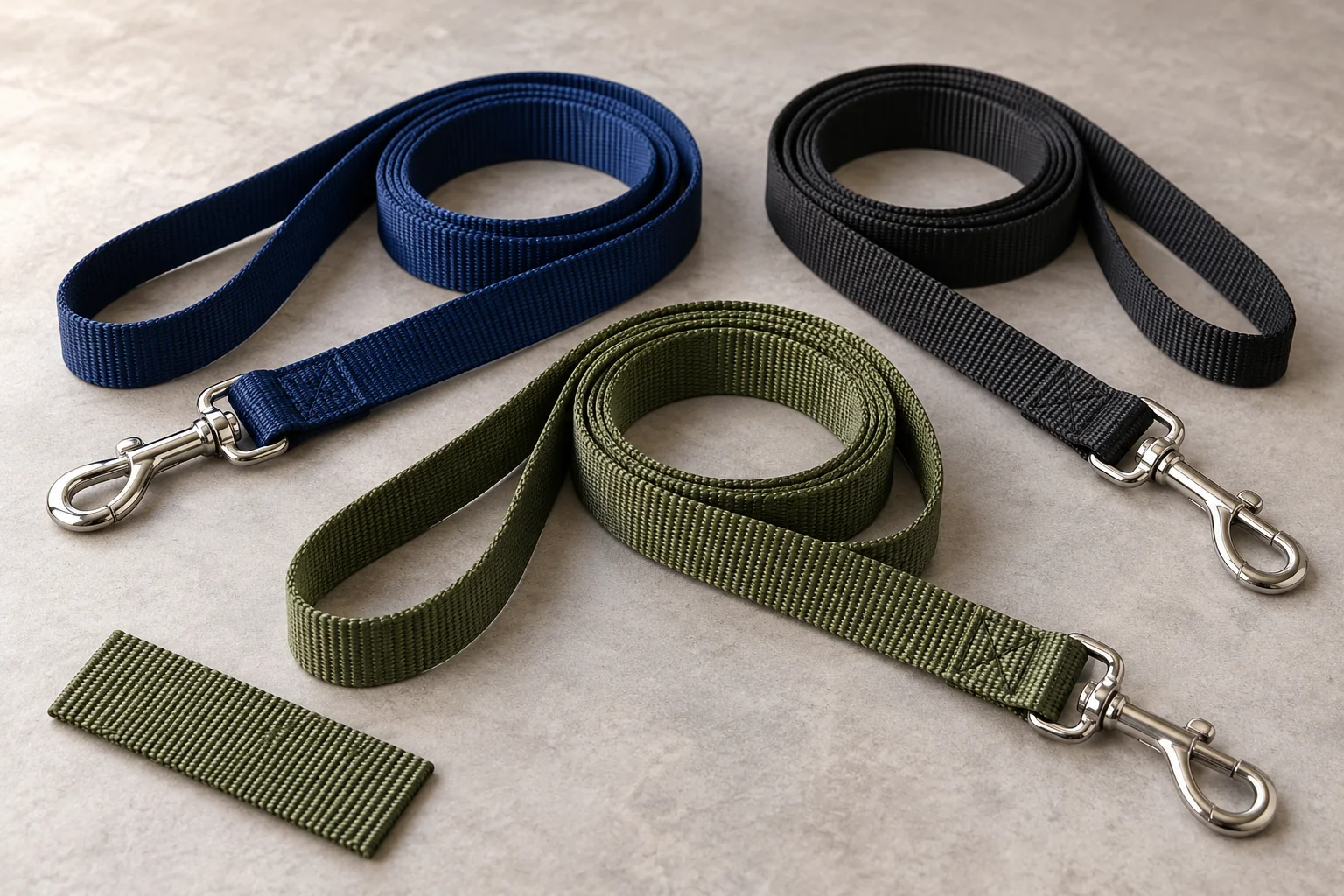
Width is easy to measure. Weave is harder to judge from a supplier catalog. Two equally wide straps may differ in yarn size, yarn count, tightness and surface pattern. One might have a pronounced ribbed texture and stand up stiffly when held; another might fold more easily and feel smoother against the hand. Those differences shape the finished product long before a customer reads a technical specification.
I would compare swatches side by side rather than call the densest-looking weave the winner. A firm strap may suit one product direction and feel unnecessarily rigid in another. Equally, a pleasant, flexible strap still needs its required performance verified. Neither weave density nor a heavier hand feel is proof of strength, abrasion resistance or suitability on its own.
For a useful sample comparison, keep the same width and intended construction where possible, label each swatch, then note the surface texture, flexibility, edge feel and how neatly it folds around the planned hook. This gives you a practical preference to discuss with the supplier instead of a vague request for “premium webbing.”
When the swatches arrive, look closely at their edges and cut ends. Loose yarns, rough patches, fraying and inconsistent texture can be noticeable in the hand even if the overall color looks correct. It is also worth inspecting the webbing where it folds at the handle and hook, because that is where a tidy flat sample turns into a real product.
A supplier reference or agreed material code is far more useful for repeat orders than “the softer black one.” Keep the selected swatch with the sample-approval record. It is much easier to discuss a problem when both sides can identify the construction without guessing.
Stitching and joining: a neat pattern is not a test result
The handle and hook connections deserve more attention than the uninterrupted length of webbing. Neat stitching is a good sign of workmanship, but a box-X pattern on its own does not prove connection strength. Its effectiveness depends on the materials and construction around it.
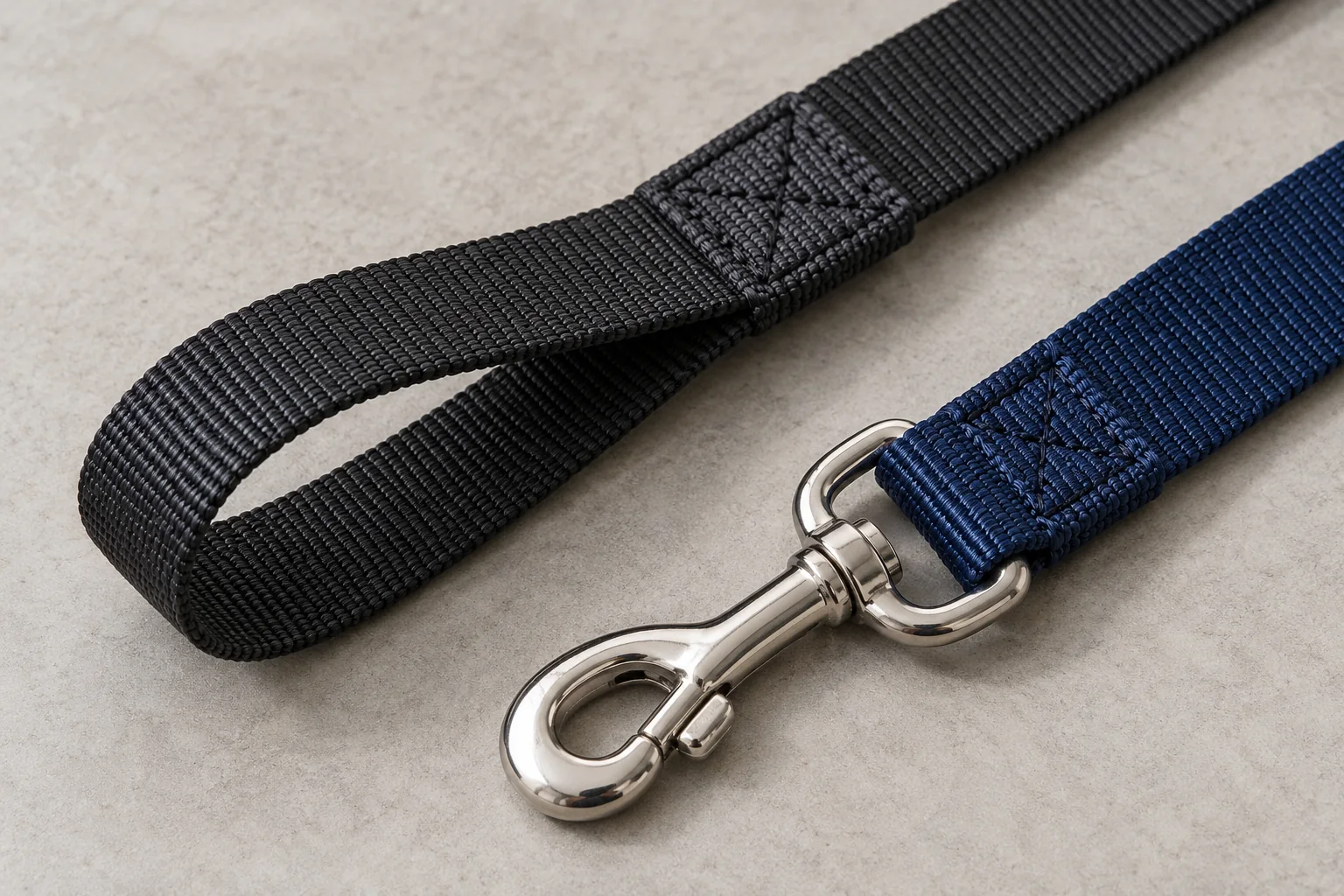
For the construction you approve, keep the fold or overlap length, thread specification, stitch pattern and stitch density or spacing in an agreed form. Close-up photographs with a scale are helpful. The goal is not paperwork for its own sake: it is to give production and inspection teams the same reference.
On a production sample, look for skipped stitches, loose ends, irregular spacing, distorted webbing and inconsistent folds. If something is wrong, describe the exact connection and proposed change. “Make the stitching stronger” sounds decisive but leaves too much room for interpretation.
For example, if a larger hook forces a different fold at the attachment point, do not approve the new hook and assume the old joining specification still applies. Review the assembly and decide whether additional evaluation is needed. A component change can become a construction change.
Hardware: does the hook suit this particular leash?
A shiny hook in a catalog is not enough to make a decision. Compare candidate hooks on the finished leash, noting the model, base material, dimensions and finish. Open and close the gate several times. Does it return properly? Does the swivel move freely? Does the hardware feel awkwardly heavy next to the chosen webbing?
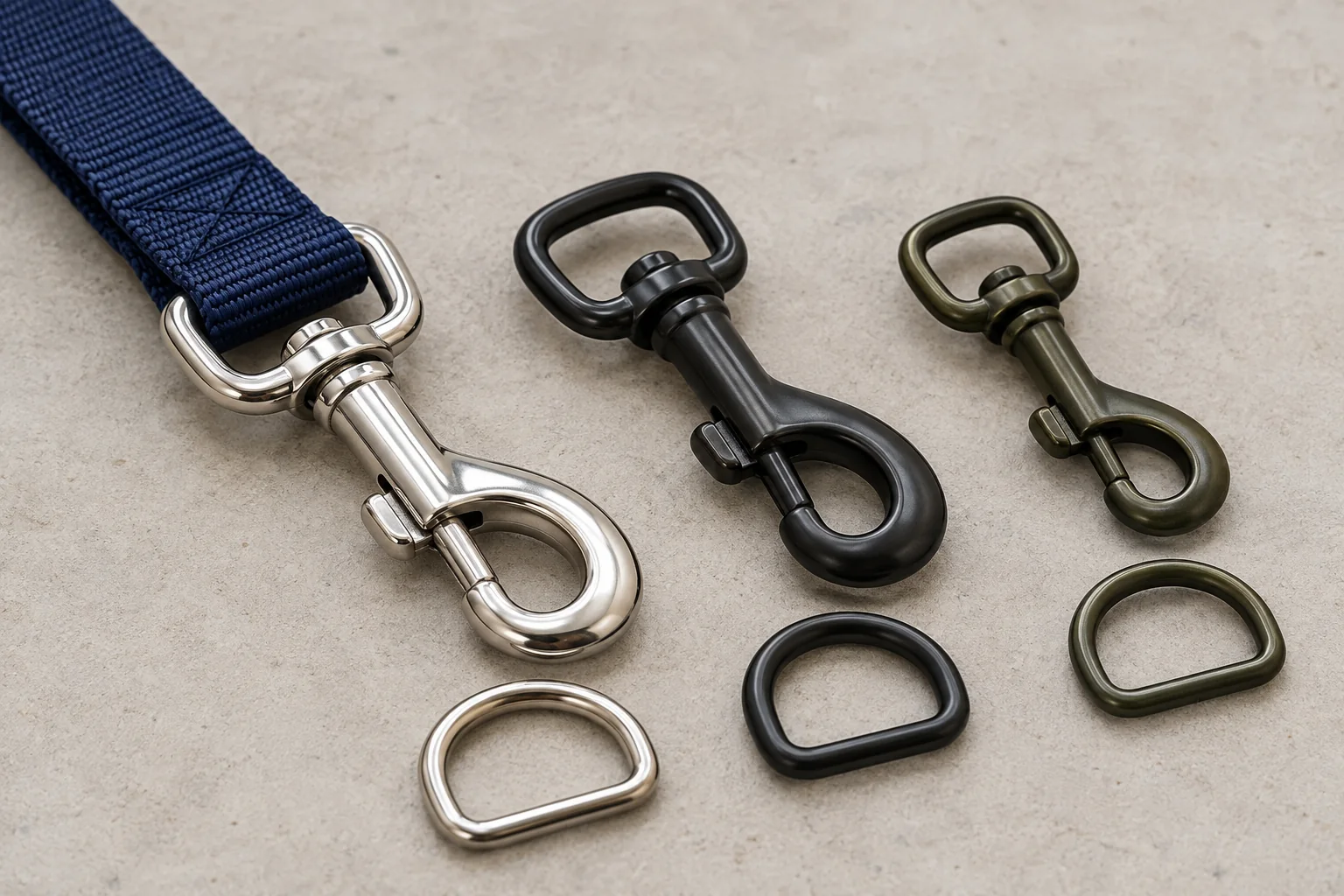
The areas contacting the webbing should be free of obvious rough edges. For matching collar-and-leash sets, place the metal components together under the same light; finishes that look similar in separate photos may not match in person. Appearance matters, but a polished surface alone says nothing conclusive about function or corrosion resistance.
Any proposed performance claim needs evidence appropriate to that exact product. For testing, agree on the finished assembly version, method, conditions, sample quantity and acceptance criteria with the supplier and a suitable testing provider. A report for a hook alone is not evidence that the full leash meets the same claim.
Customization and packaging: make hidden costs visible
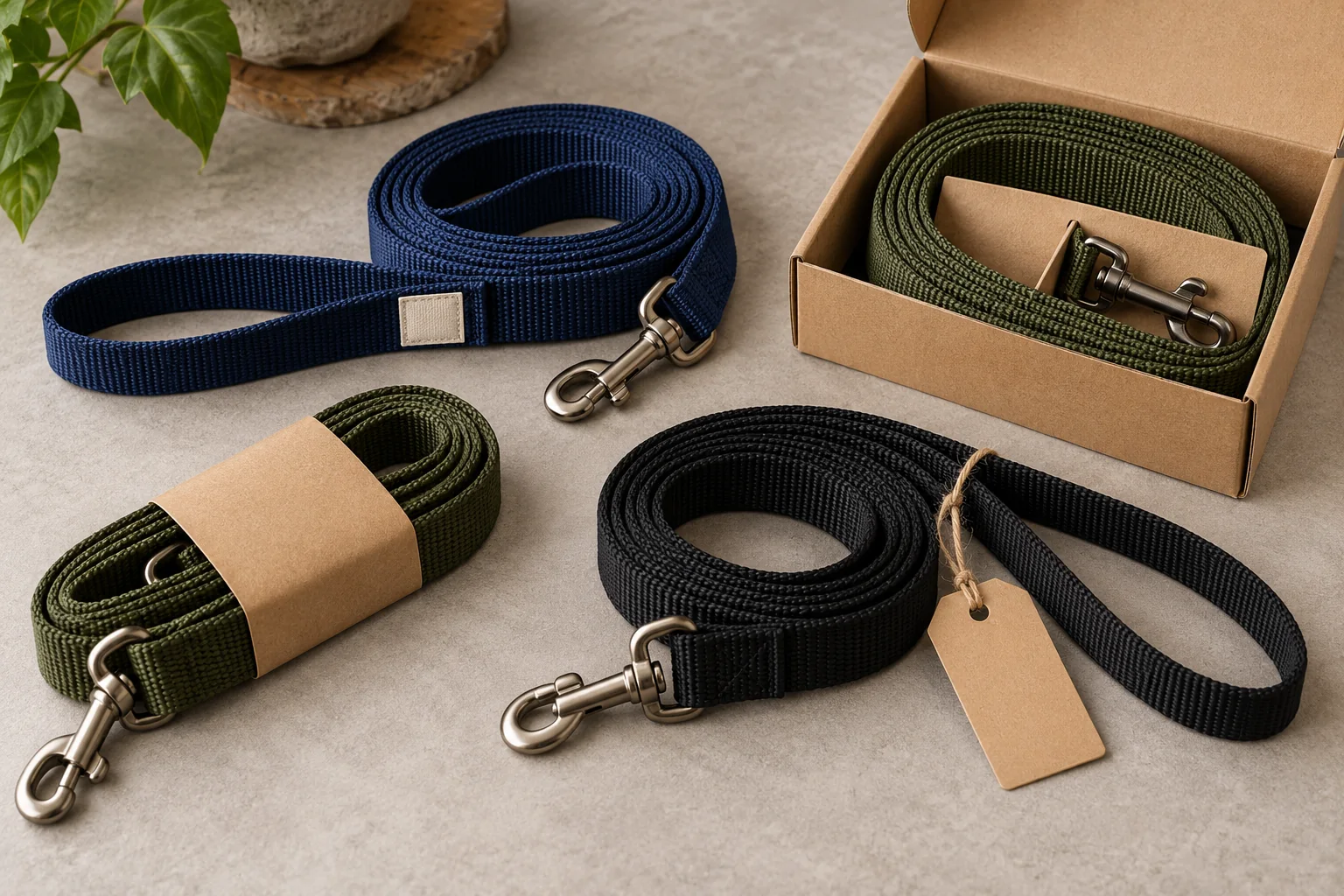
Branding is easier to assess on the real material than on a screen. A logo may look balanced in a mockup yet feel bulky near the grip or read poorly against textured webbing. Review the actual method, attachment and placement before treating the artwork as final.
The approved sample should settle future arguments
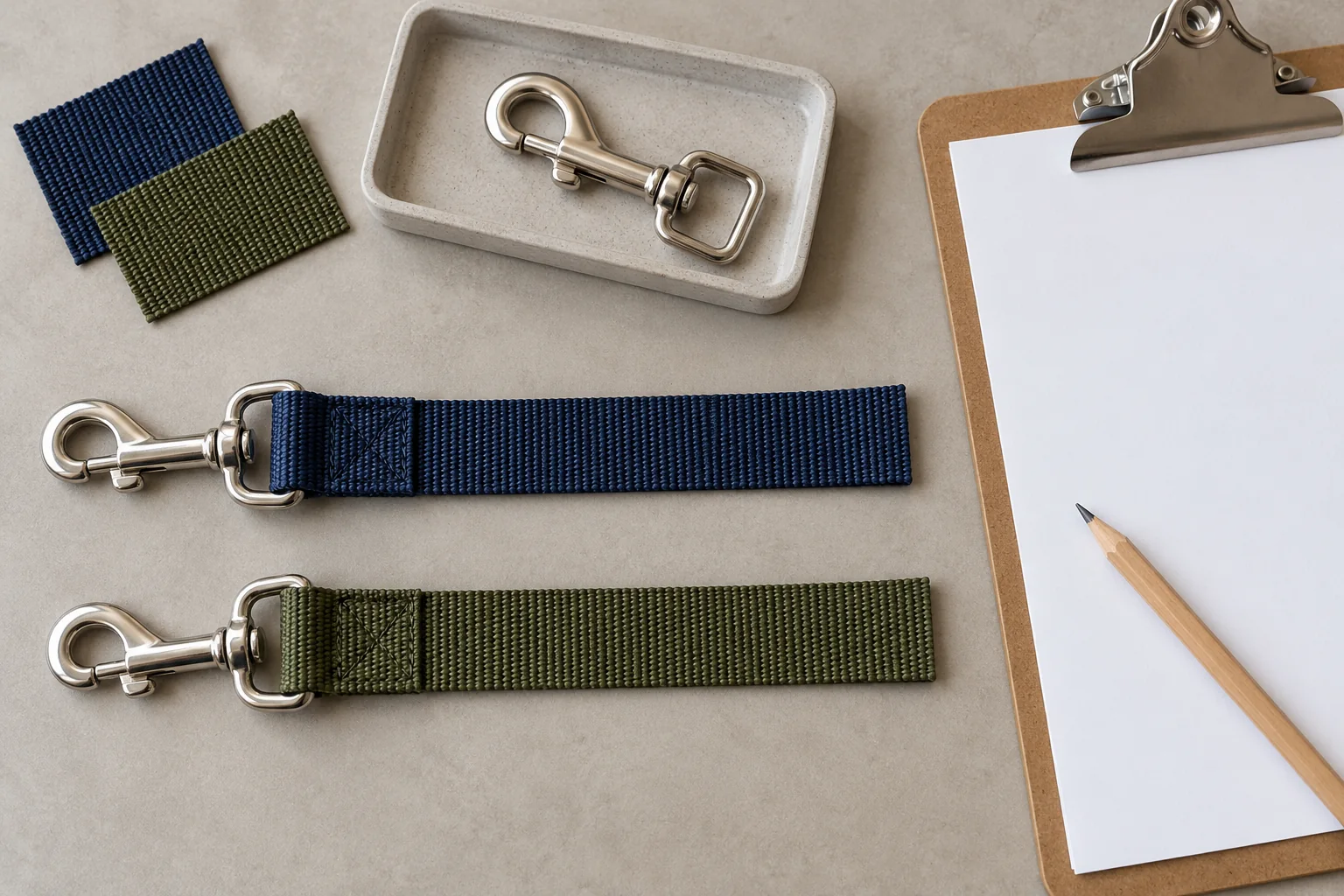
A good sample approval record answers a simple question six months later: “Which exact product did we agree to make?” Keep a version for each approved construction, with a clear note of the sizes and colors it covers. The record below is deliberately practical: it should help someone check a shipment, not just fill a folder.
|
Record |
What to keep |
|---|---|
|
Version and scope |
Sample code, approval date, version, size, color and the person approving it. |
|
Materials and dimensions |
Webbing reference and composition, finished dimensions, measurement methods and agreed tolerances. |
|
Hardware and joining |
Component references, finish, fold details, thread and stitching specifications, plus clear close-up photos. |
|
Appearance and handling |
Approved color and logo references, handle design and any agreed workmanship examples. |
|
Performance evidence |
Relevant report or test-plan references tied to the exact assembly version. Keep visual approval separate from test approval. |
|
Packaging and open items |
Packed sample or approved artwork, barcode details, requested revisions and anything still awaiting approval. |
After approval: what if production needs to change?
The first good sample is a starting point, not evidence that a full order will be consistent. Agree in advance which features will be checked during production, when samples will be reviewed and how changes are authorized. If the process is undefined, even a sensible substitution can turn into a disagreement.
A practical response to a proposed substitution
Hypothetical example: the supplier says the approved swivel hook is unavailable and proposes a similar-looking replacement. Use the following sequence before authorizing it.
- Ask the supplier to identify the original and proposed component references and explain the differences in material, dimensions, finish, function, price and availability.
- Request a revised finished sample or the other evidence needed to assess the change. Compare the connection, handling and appearance with the approved assembly.
- Determine whether the change affects existing performance evidence or requires further testing. Record the approval decision and update the specification before use.
If a difference is found after the shipment arrives, first identify the affected SKUs, batches or cartons. Photograph the issue alongside the approved reference and separate what you can observe from what you think caused it. A proposed resolution is easier to assess when both sides are looking at the same evidence. Agree on how affected stock will be handled before releasing it.
The same logic applies to webbing, thread, logos and packaging. Some changes are minor; some alter the look, fit or performance of the product. The mistake is not discussing alternatives—it is treating an unapproved replacement as if nothing changed.
How to start a useful inquiry—even without a complete specification
Most buyers do not begin with a perfect specification, and that is fine. A reference image, a rough product direction and two or three clear questions can start a more useful conversation than a long checklist filled with guesses. Here is an example of a practical first message:
“We are developing a private-label nylon dog leash based on the attached reference photo. We like the handle shape but are still comparing webbing feel and hook options. Our target is an everyday retail product. Could you show us a few suitable constructions and explain the differences? We can share estimated quantities, logo artwork and packaging ideas as the specification develops.”
As the discussion progresses, you can ask for the final quotation to separate product price from sampling, setup, testing, freight and other relevant charges, with the delivery basis clearly stated. Before placing an order, reconcile that quotation with the approved sample and written specification. At that point, clarity is worth more than another round of vague price negotiation.
Developing a Nylon Dog Leash? Let’s Talk About Your Idea
You do not need a complete product specification to start a conversation with AGL. Perhaps you have a reference photo but are unsure which webbing or hook to choose. Perhaps you have a sample and want to improve the handle, stitching or packaging. Send us what you have and tell us what you would like to change.
We can discuss the options available for your project, clarify the decisions that matter and work toward a specification for sampling and quotation. Quantities, sampling arrangements and lead times can be confirmed for the actual design as the discussion moves forward. A reference image and a short message are enough to get started.
Your Reliable Pet Products Partner
Tell Us About Your Pet Product Project
Sample Evaluation
Confirm sample availability, any charges and freight before reviewing the product.
OEM Customization
Review product-specific branding, material and packaging options before sampling.
Production Planning
Agree on production lead time and shipping handover after sample approval.
Responsive Support
From initial consultation to after-sales, we’re with you in every step.