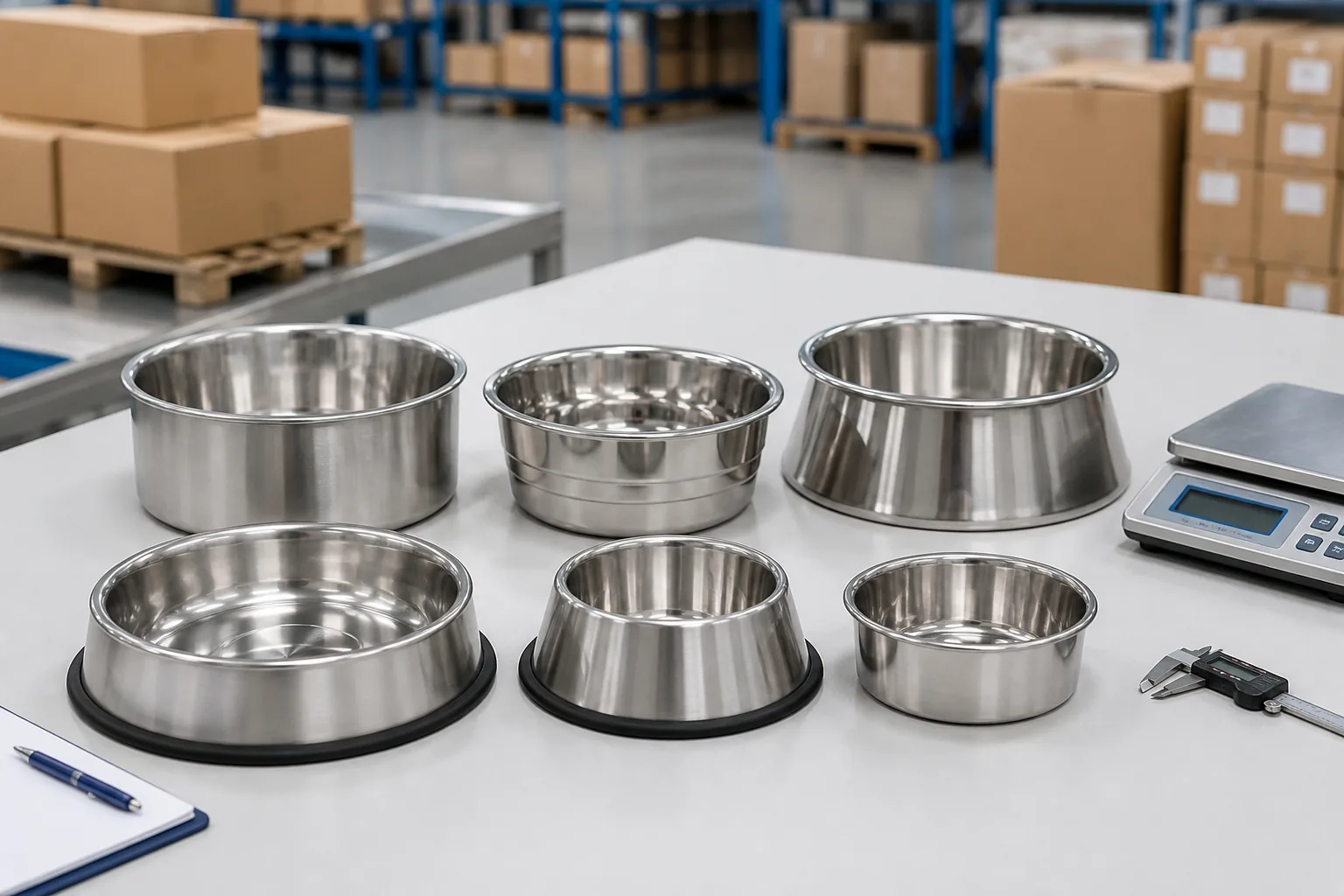
Put three stainless steel dog bowls on a sample table and, at first glance, they may look almost identical. Turn them over, weigh them, run a finger around the rim, and wash them a few times, and the differences start to show. One feels solid; another rocks on the floor. One keeps its finish; another arrives with rub marks after being nested in a carton. This is where a buyer’s job begins – beyond the product photo.
The most common sourcing mistake is asking, “What is your price for this bowl?” before deciding what “this bowl” actually means. A supplier will still quote, but the missing details do not disappear; the supplier fills them in. Usually, those choices favor the easiest or cheapest production route, which may not match the buyer’s market.
This guide follows a buyer’s decisions from RFQ to shipment release. It is for anyone comparing stainless steel dog bowls wholesale, a dog water bowl supplier, or a private-label program – and anyone who knows a low quotation is useful only when the specification is clear.
Start With a Clear Sourcing Brief
Before I compare suppliers, I ask what job the bowl must do. Is it a value item or a heavier product meant to look good in an unboxing video? Is it for puppies, large dogs, travel, or daily use? The answers change the weight, capacity, base, finish, package, and cost.
Your sourcing brief should state:
- Target customer, retail channel, and target retail price
- Intended bowl size, usable water capacity, and dog-size positioning
- Stainless steel grade or minimum performance requirement
- Single-wall or double-wall construction
- Finished product weight and tolerance
- Surface finish, rim style, and anti-slip base design
- Logo method, artwork position, and packaging format
- Target market and required compliance documents or tests
- Forecast order quantity, trial quantity, and expected reorder schedule
A clear brief stops five suppliers from quoting five different bowls under the same photo. It also gives the buyer an objective reference when a sample is light, a logo shifts, or inspection fails.
Choose the Right Stainless Steel Grade
I never treat “stainless steel” or “food grade” as a complete material answer. Neither phrase identifies the alloy, supporting documents, or finished-bowl performance. Common options include 304, 316, and 430, each with a different cost and use case.
| Grade | Common commercial description | Typical sourcing position | Buyer consideration |
|---|---|---|---|
| 304 | Often described as 18/8 stainless steel | Common choice for reusable household and pet bowls | Good general corrosion resistance when correctly made, finished, cleaned, and stored |
| 316 | Molybdenum-bearing stainless steel | Premium or demanding environments | Greater resistance in chloride-containing environments, but higher material cost |
| 430 | Often described as 18/0 stainless steel | Cost-sensitive applications | Magnetic and lower in nickel; performance must be evaluated against the intended use |
304 is often a sensible starting point, but the label alone does not earn approval. Poor polishing, iron contamination, crevices, or wet storage can still cause staining. Grade 316 adds resistance in some environments, but a higher-cost alloy does not repair weak workmanship. Grade 430 can fit a cost-sensitive program when its limits are understood.
A magnet can raise a question, not close one. Cold working may make some austenitic stainless steels slightly magnetic, and magnetism does not confirm composition. Ask for a material declaration and mill documentation, then scale verification to risk. For a large or reputation-sensitive order, XRF screening or laboratory analysis may prevent a much costlier dispute.
Specify Construction, Thickness, and Finished Weight
Construction is where two quotations often stop being comparable. A single-wall bowl is lighter and nests efficiently. A double-wall bowl feels more substantial, but joints, bonding, trapped moisture, leakage, and base flatness add risk.
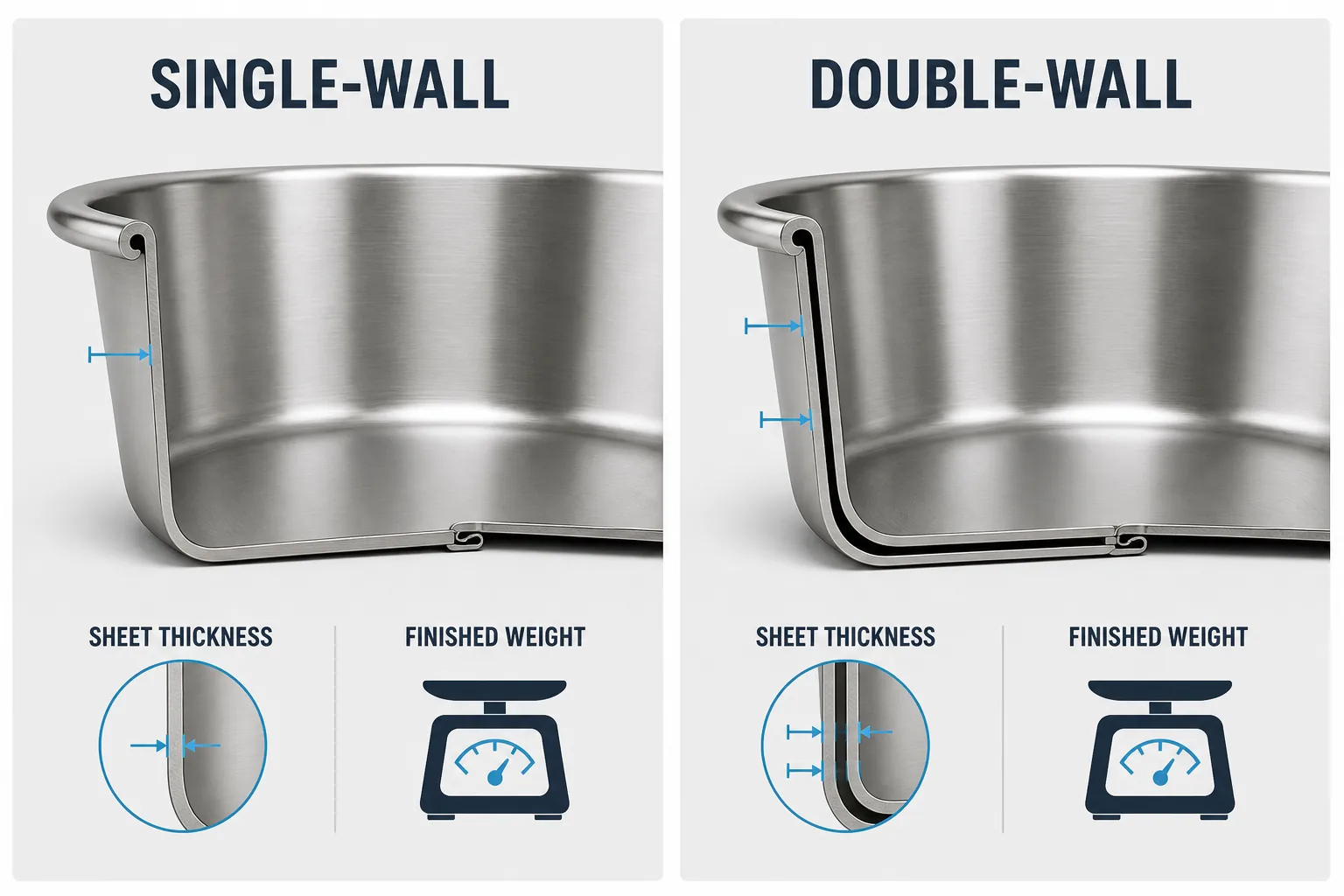
“Heavy duty” is not an inspection method. Ask for starting sheet thickness when available, but also record finished weight and tolerance. Forming changes local thickness, so one reading on a curved bowl can mislead. Weight, dimensions, construction, and an approved sample work better together.
For double-wall models, identify how the two shells are joined and whether the base is welded, bonded, or mechanically assembled. Include leak, separation, rocking, and trapped-water checks in the quality plan. For every design, inspect the rim carefully: it should be smooth, securely rolled or finished, and free from sharp edges, burrs, cracks, and visible deformation.
Confirm Size, Capacity, and Drinking Geometry
Catalogue diameter is easy to understand, but not enough to buy the product. Put top diameter, base diameter, height, inner depth, rim width, and silicone-base dimensions on one drawing. These numbers decide whether the bowl fits a stand, nests, sits flat, and matches its package.
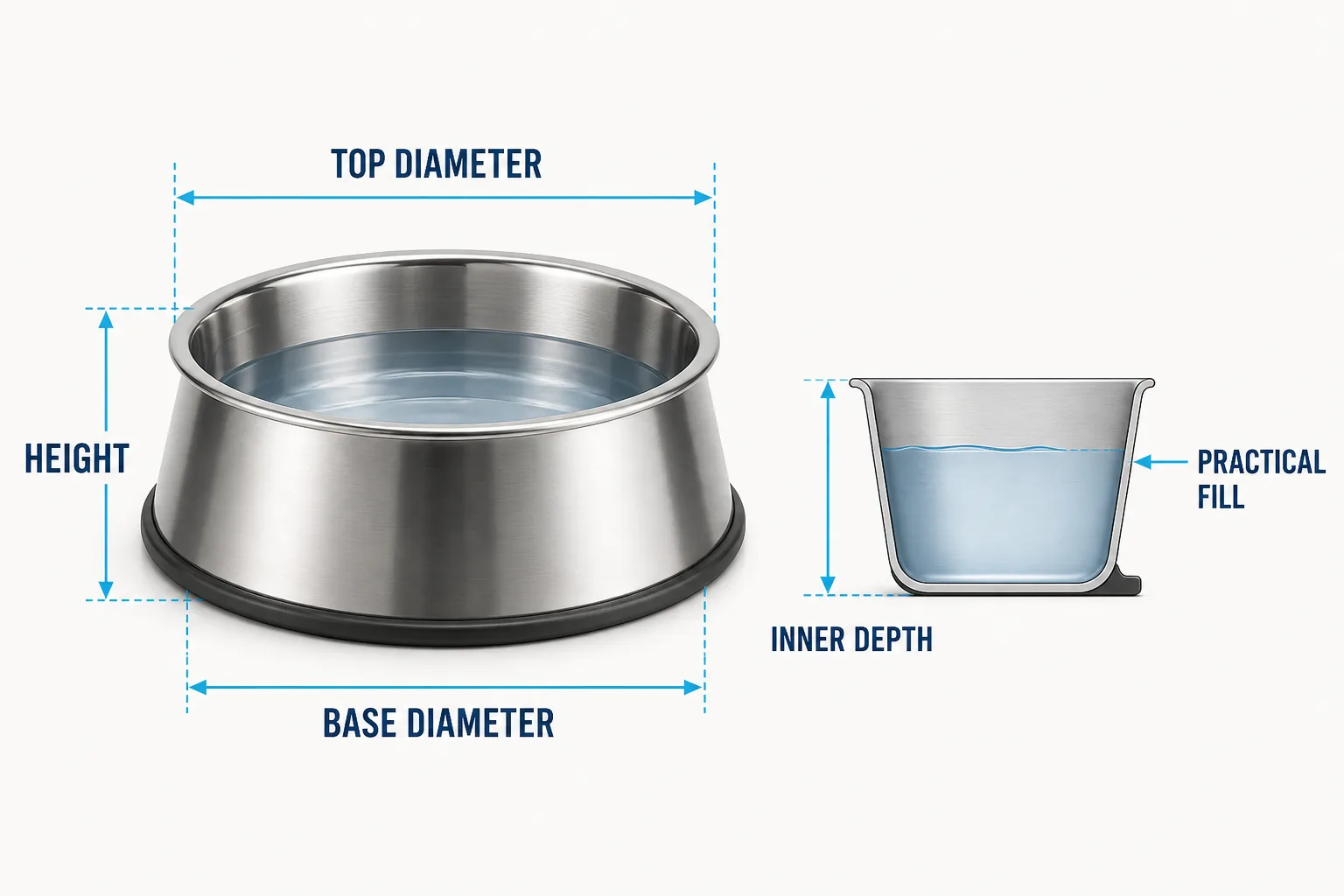
Capacity is another quiet source of disagreement. A factory may fill the sample to the rim and call that the capacity; a customer will never use it that way without spilling water. Agree on total capacity and practical fill capacity, including where the water line sits. Shape matters too: a broad base helps stability, while a narrow opening or excessive depth can make the stated volume less useful in real life.
If the product will be marketed by dog size, validate the positioning with real use scenarios rather than copying a competitor’s label. Product dimensions, water volume, floor space, and refill frequency should support the claim.
Set Standards for Surface Finish and Workmanship
I inspect samples under room light and stronger side light. The second view reveals ripples, polishing lines, dents, and scratches that photos hide. Mirror, satin, brushed, and matte finishes age differently, so choose one the factory can repeat and customers can live with, not merely the best-looking sample.
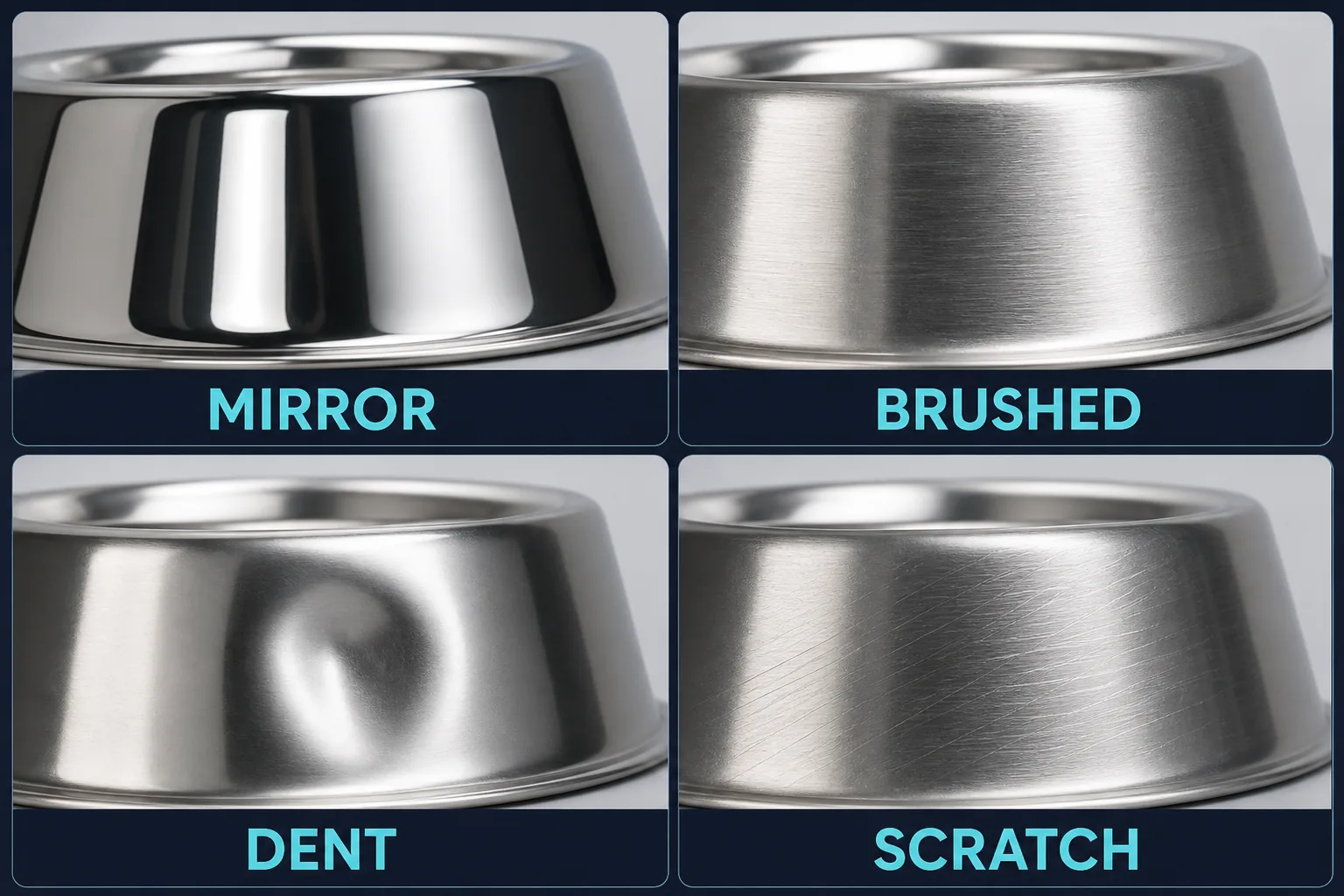
The inner surface should be smooth and easy to clean. Inspection should cover polishing lines, dents, ripples, pits, stains, discoloration, weld marks, uneven rims, and embedded particles. Buyers should also specify whether minor marks are acceptable on hidden areas. For a retail product, cosmetic standards need to cover both the bowl and the packaging because the customer sees them as one unit.
Evaluate the Anti-Slip Base
A slip test feels simple until a full bowl moves across tile or its base ring falls off. “Non-slip” means little without material, contact area, hardness, and attachment method. Common designs include a removable silicone ring, bonded rubber base, feet, or a full sleeve.
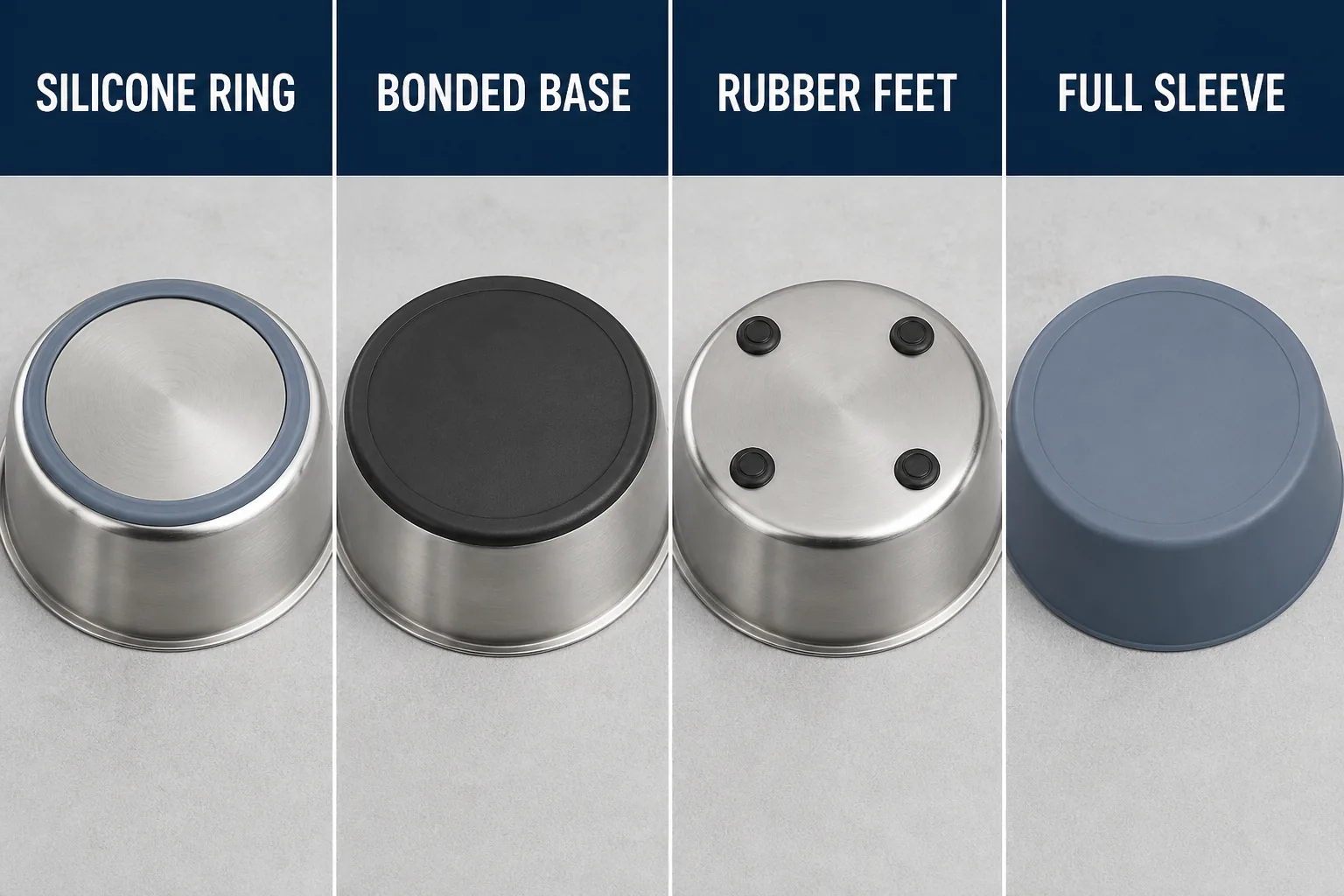
Ask the supplier to identify the base material and hardness, especially when making silicone-related claims. Test the bowl on tile, wood, laminate, and other surfaces relevant to your market. Check whether the base stays attached after washing, leaves marks or odor, traps water, or becomes loose over time. If dishwasher-safe performance is claimed, test the complete bowl with the base, decoration, adhesive, and finish included.
Treat Safety and Compliance as Finished-Product Requirements
A certificate is not the product. A report for one material or old sample does not approve every size, color, logo, coating, and accessory. Read compliance against the target market, intended use, bill of materials, and exact ordered configuration.
List the steel body, silicone or rubber parts, coatings, inks, adhesives, labels, and packaging. Check which item, batch, and method each report covers, and whether the supplier, dates, and tested configuration match the order.
For food-contact markets, verify rules and documents for the finished product and foreseeable use. The EU applies general safety and good-manufacturing requirements, with additional rules possible by material and country. In the US, status depends on the substance and intended conditions of use. Obtain destination-market advice instead of relying on vague “FDA approved” or “EU certified” claims.
Also review labeling and claim substantiation. Statements such as dishwasher safe, rust resistant, non-slip, or BPA free should be accurate for the relevant component and supported where necessary. Stainless steel bowls are metal products and should never be promoted as microwave safe.
Plan Customization Before Sampling
Customization can turn a stable blank bowl into a risky SKU. For custom stainless steel dog bowls and private label dog bowls, plan decoration before sampling. Engraving, printing, embossing, coatings, silicone parts, labels, and color boxes each add a different failure point.
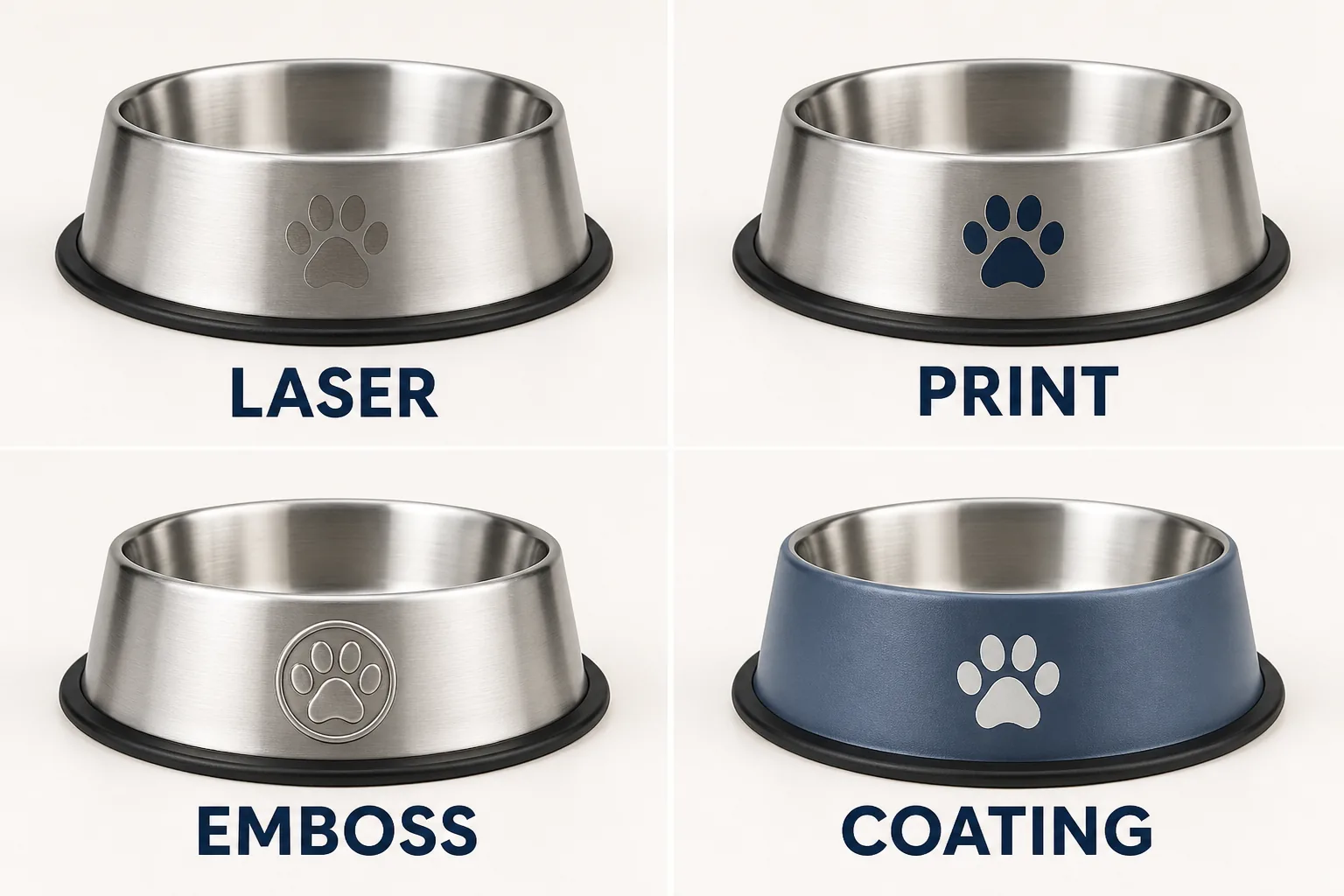
Laser marking is durable and clean but offers limited color. Printing gives more visual flexibility, yet adhesion and abrasion performance must be tested. Coatings create a strong shelf appearance but add requirements for color control, surface preparation, scratch resistance, and contact-area management.
Provide vector artwork, color references, dimensions, position, orientation, and acceptable variation. Approve a decorated sample, not only a blank bowl. If the logo is applied near the drinking surface or if a coating can contact water, confirm that the complete decorated product meets the relevant requirements.
Build a Practical Quality-Control Plan
A good inspection checklist is boring – and that is a compliment. It leaves little room to “feel” differently about a defect. Start with a sealed golden sample, then turn each promise into a method, tolerance, sampling approach, and pass/fail rule.
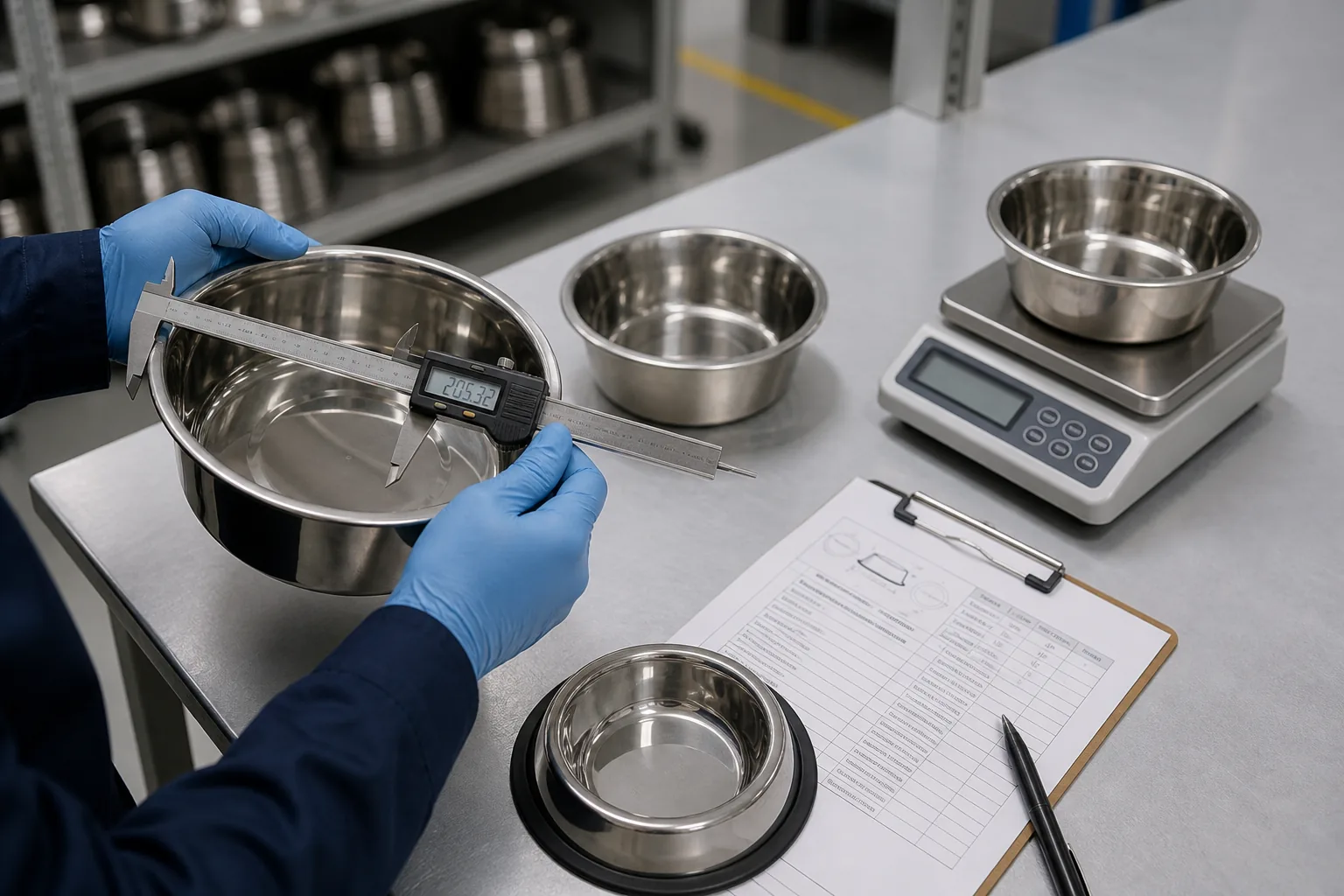
Typical checks include:
- Material identity and supporting traceability documents
- Product dimensions, capacity, finished weight, and tolerances
- Rim smoothness, sharp-edge inspection, and general workmanship
- Surface finish, stains, dents, scratches, and logo position
- Stability, rocking, anti-slip performance, and base adhesion
- Leakage or shell-separation checks for double-wall products
- Corrosion or exposure testing appropriate to the intended use
- Cleaning or dishwasher-cycle tests when such claims are made
- Odor and appearance checks for silicone or rubber components
- Barcode scan, label accuracy, assortment, and carton count
- Packaging integrity, carton dimensions, and agreed drop or transit tests
Classify defects before shipment pressure begins. A hidden cosmetic mark is not the same as a sharp rim, wrong material, or loose part. Use an agreed sampling plan, then choose in-process inspection, pre-shipment inspection, or laboratory testing according to order value, supplier history, and failure cost.
Compare MOQ, Price, and Total Landed Cost
A low FOB price can hide inefficient cartons, scratched stock, rework, testing, or returns. Steel grade, weight, forming, polishing, assembly, anti-slip parts, decoration, packaging, quantity, and inspection all affect price. The quotation is only one line in the cost story.
Ask suppliers to itemize optional features and quote on the same Incoterm, currency, quantity, and packaging basis. Clarify tooling, sample, artwork, mold, testing, and setup charges. Confirm whether the MOQ applies per size, logo, color, or packaging design.
Calculate landed cost using product price, inland transport, export handling, freight, insurance, duties, import taxes, inspection, testing, warehousing, and expected defect allowance. A slightly more expensive bowl that nests efficiently and arrives with fewer scratches can produce a better commercial result.
Engineer Packaging for Protection and Freight Efficiency
Do not approve packaging from a drawing alone. Open a production-equivalent carton and inspect bowls from the middle and bottom of the stack. Nesting saves space, but metal contact causes rub marks. Sleeves, tissue, bags, or dividers should protect the finish without trapping moisture.
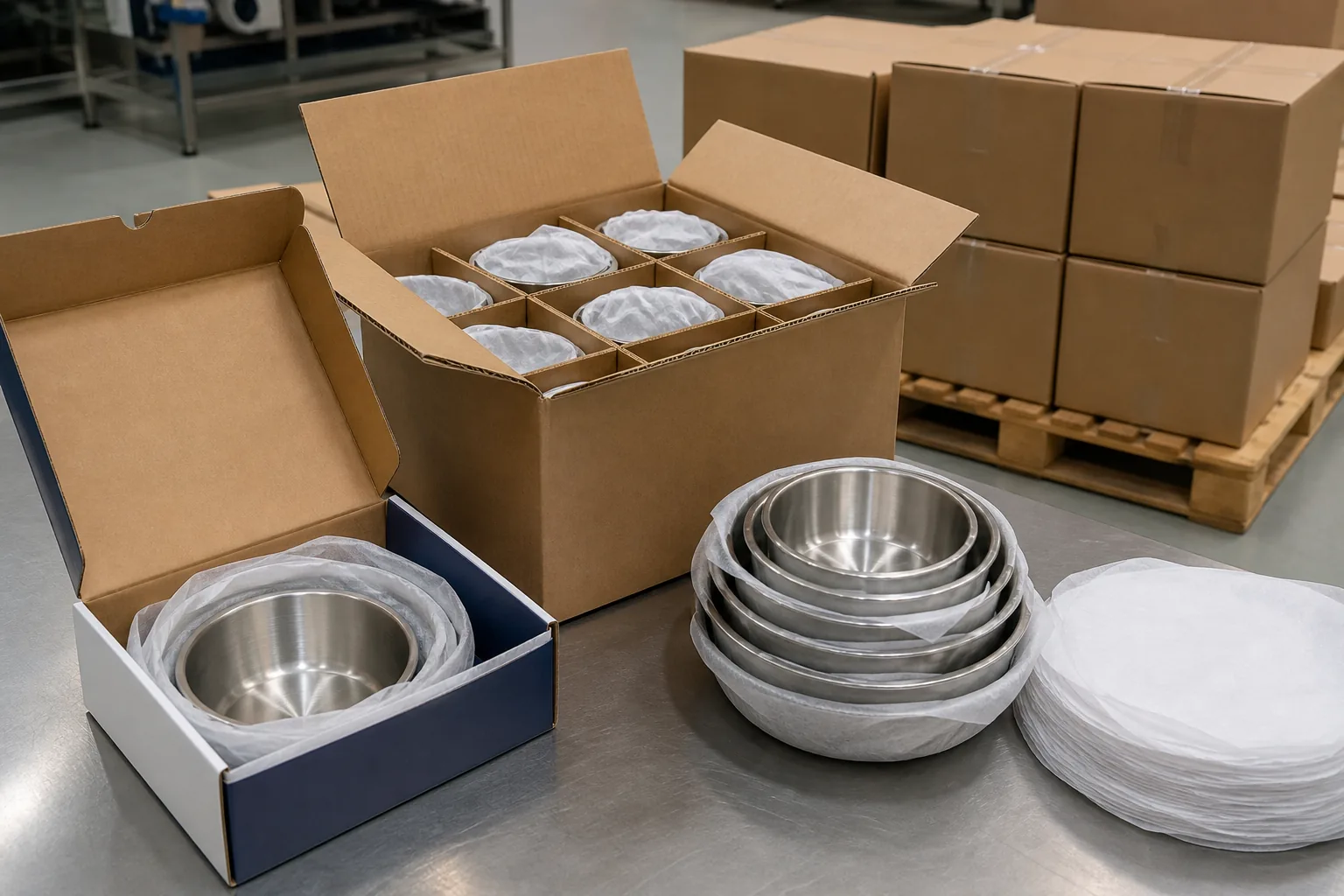
For e-commerce, the retail package may also need to survive parcel delivery without denting the bowl. For wholesale distribution, prioritize carton strength, pallet efficiency, readable markings, manageable gross weight, and accurate pack quantities. Request carton dimensions and gross and net weights before ordering so freight estimates are based on the real pack-out.
Run packaging tests on production-equivalent samples. A perfect showroom sample does not prove that 1,000 nested bowls will arrive without rubbing, deformation, or label damage.
Evaluate the Supplier, Not Just the Sample
A polished sample proves someone can make one good bowl, not repeat it 5,000 times. Ask who controls forming, trimming, polishing, cleaning, assembly, decoration, and packing. The business label matters less than clear responsibility and traceability.

Useful supplier questions include:
- What similar stainless steel dog bowls have you produced?
- How do you control raw-material identity and batch traceability?
- Which processes are subcontracted?
- What are the normal monthly capacity and peak-season lead time?
- How are weight, dimensions, polish, and rim quality checked?
- How are nonconforming products isolated and corrected?
- Can production records be linked to the shipment lot?
- What happens if inspection fails or defects are found after delivery?
Check business credentials, export experience, communication speed, document quality, and willingness to define problems in writing. A reliable supplier should be able to explain tolerances, propose test methods, and identify trade-offs instead of agreeing vaguely to every request.
Follow a Step-by-Step Sourcing Process
- Define the product and market. Decide who is buying, why they will choose it, what they will pay, where it will be sold, and how much volume is realistic.
- Issue a measurable RFQ. Include drawings, grade, construction, weight, capacity, finish, base, logo, packaging, testing, and commercial terms.
- Shortlist comparable suppliers. Compare prices, but read footnotes and omissions just as carefully.
- Order samples. Evaluate blank and customized versions, preferably from production-representative processes.
- Verify materials and claims. Review traceability, test reports, and destination-market requirements; commission additional testing where justified.
- Approve a golden sample. Record dimensions, weight, appearance, packaging, artwork, and any agreed limit samples.
- Place a controlled trial order. Use it to learn about production, packaging, freight, and customer response.
- Inspect before shipment. Apply the agreed sampling plan and defect classifications, then close corrective actions before release.
- Review actual performance. Track scratches, rust-related complaints, base failures, returns, and packaging damage by batch.
- Improve the next purchase order. Write complaints and inspection lessons into the next PO, or the team pays to learn them again.
Frequently Asked Questions
Is 304 always the best stainless steel for dog water bowls?
304 is a common choice, but “best” depends on environment, design, finish, cleaning, price, and market requirements. Grade selection cannot replace workmanship and testing.
Is 316 stainless steel worth the extra cost?
316 offers more resistance in some chloride-containing environments, but its extra cost is not justified for every indoor bowl. Compare environment, warranty risk, positioning, and verified material cost.
Can a magnet identify 304 stainless steel?
Not conclusively. Manufacturing can change magnetic response, and magnetism does not provide a full chemical analysis. Use documentation and, when risk warrants, positive material identification or laboratory testing.
What is the most useful thickness specification?
Specify starting sheet thickness when available, plus finished weight, dimensions, and tolerances. Forming changes local thickness, so combined measurements beat a vague “heavy-duty” claim.
How can a buyer reduce rust or staining complaints?
Choose suitable material, control crevices and contamination, validate cleaning, keep packaging dry, and give realistic care instructions. Investigate complaints by batch; orange staining has several possible causes and does not prove the base grade by appearance alone.
Conclusion
If I had to reduce this guide to one rule, it would be this: buy the specification, not the photograph. Define the grade, construction, finished weight, dimensions, finish, base, claims, packaging, and inspection rules before the pressure of a live order begins. Then verify the decorated finished product, not just the attractive blank sample.
A clear specification makes negotiation calmer, comparisons fairer, and corrective action faster. Send the same measurable brief to each supplier and ask for written exceptions. How well they answer often reveals their production discipline.